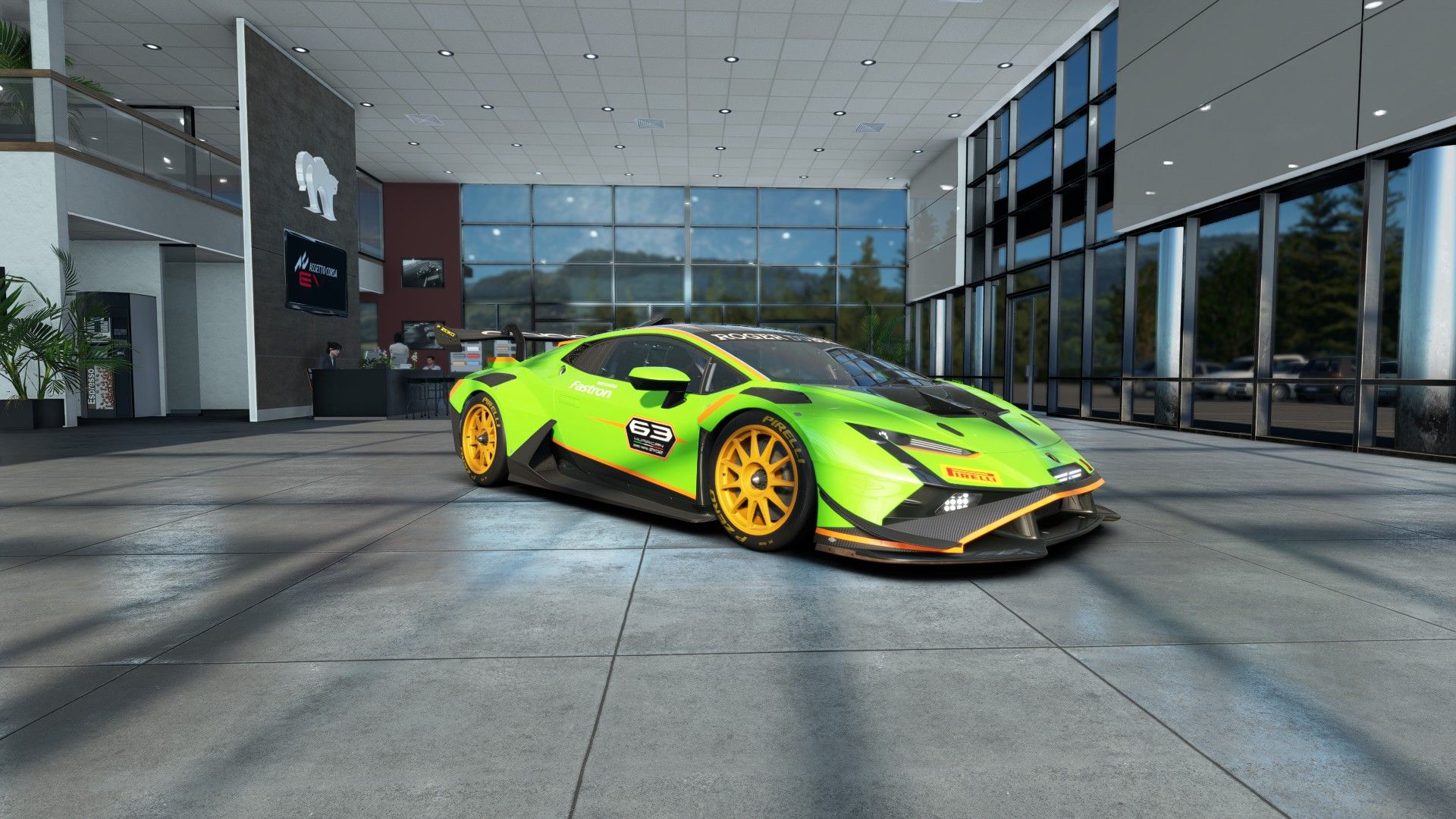
There's a widespread idea that using driver aids is for beginners. It's false in most cases, and understanding why saves wasted time.
A real GT3 has ABS and traction control as standard, adjustable from the wheel, and professional drivers use them and change them during a race. Turning them off in the sim doesn't bring you closer to reality: it takes you further away.
A classic car or a formula car without electronics is different: there the aids are a sim addition and learning without them is worth doing.
So the right question isn't "aids or no aids" but "what level makes me faster in this car at this track?"
ABS detects a wheel about to lock and releases brake pressure on it, many times a second, so it keeps rotating.
Why that matters: a locked wheel doesn't brake better, it brakes worse, and it doesn't steer. A two-second lock-up in a heavy braking zone sends you straight on and leaves you a flat spot for the rest of the stint.
It detects the driven wheels turning faster than the car — that is, spinning — and cuts or reduces power until they hook up again.
An important nuance: traction control acts after the wheel spins. It doesn't prevent wheelspin, it cuts it. Which is why a smooth foot is always faster than trusting the electronics.
| Situation | ABS | Traction control |
|---|---|---|
| Learning the track | Medium | Medium-high |
| Qualifying, dry | Low | Low |
| Long race | Medium | Medium: looks after the tyres |
| Full tank | Medium | One step above normal |
| Rain | High | High |
| Worn tyres | One step up | One step up |
| Bumpy track | One step up | Same |
And the general rule that covers everything: the right level is the lowest one where you don't lose time. If you never notice the aid working, it's redundant. If it forces you to lift, it's insufficient.
It depends on the car:
There is one case for lowering them even when you don't have to: learning the limit. Running a few sessions with the aids at minimum teaches you where the edge is. Then put them back and you'll drive better with them.
Dropping them all at once doesn't work: you lose seconds, get frustrated and turn them back up. The progression that does work:
And don't do it in the week of an important race. This is practised in loose sessions, not on the round that counts.
In cars that don't have it in reality, yes, because the sim's model assumes it isn't there. In a GT3, which has it as standard, no: ABS is part of the car, and removing it isn't more realistic, it's less.
The lowest one where you don't lose time. If you feel the rear moving on slow corner exits and have to lift, go up a step. If you never feel it intervene, go down one.
In almost every competition car, yes, and you should: in the rain, on worn tyres or with a full tank, one more step of assistance makes you faster, not slower.
Traction control does reduce wheelspin on exit, and that extends rear tyre life. It's a legitimate reason to run one step higher in long races.
What it is, why it rotates the car, how to practise it and the mistakes that end in a spin.
Read →What each click does, how it shows up at the rear axle and how to find your value.
Read →What each parameter does, what order to touch them in and how to spot clipping.
Read →Change one step, run five laps, compare. On the 24/7 there's nothing at stake.
 assettocorsaevo