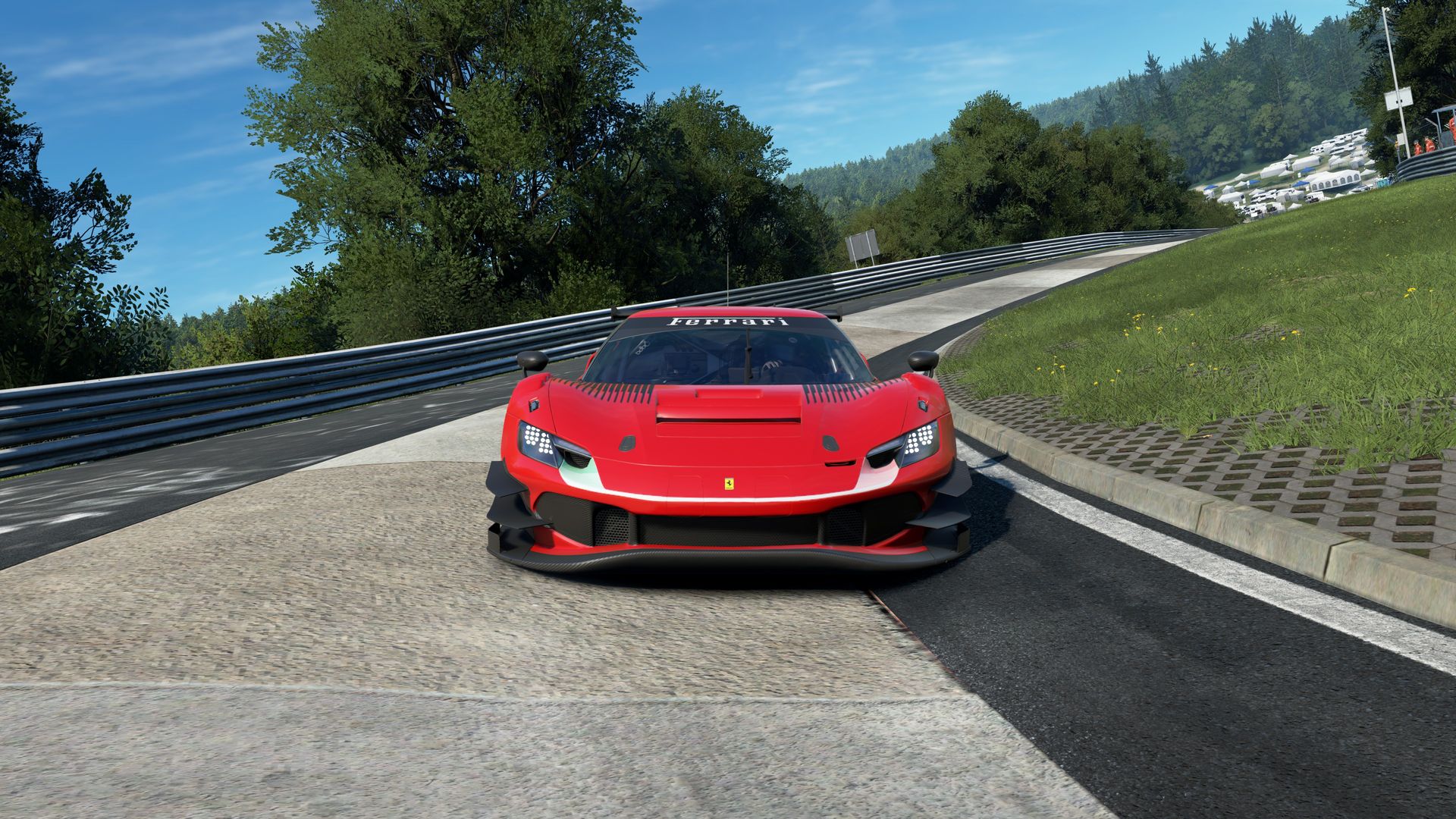
Trail braking means continuing to release the brake progressively while you are already turning, instead of finishing all your braking in a straight line and then turning.
Put another way: your brake foot doesn't make a step — hard, then nothing — but a ramp that comes down as the steering goes up. On a graph, brake pressure and steering angle cross over.
The driving-school version says brake straight, release, turn. It's safer and it's slower. Every quick driver overlaps those phases.
Two reasons, and both are worth understanding because they explain when it works and when it doesn't.
When you brake, weight shifts forward and the front tyres are pressed into the tarmac. More weight on them, more grip available. If you release the brake completely before turning, that weight goes back just when you needed the nose most.
Keeping some brake into the corner keeps the nose loaded, and the car goes where you point it.
The same movement lightens the rear. A rear axle with less load has less lateral grip, so the back follows the nose more willingly. The car rotates.
Which gives you the full rule: trail braking lets you change the car's balance at will, in the middle of a corner. It's a setup change you make with your right foot.
The mental image that works best: think of the brake and the steering as joined by a balance. Whatever you take from one, you give to the other, and the total stays constant.
| Corner type | How much trail | Why |
|---|---|---|
| Slow hairpin | A lot | You need rotation; the car is slow and forgiving |
| Medium 90° | Medium | The classic trade-off between entry and exit |
| Fast corner | Very little or none | With downforce the nose already grips; dragging brake unsettles the rear |
| Chicane | A lot on the first part | You rotate early to line up for the second |
| Downhill corner | Little | The slope already loads the nose; the rear is marginal |
| Uphill corner | More than usual | The climb plants the car and gives you margin |
Quick rule: the faster the corner, the less trail. In quick corners a mistake costs you a spin you won't catch.
Learning it at race pace doesn't work. This does:
A trick that speeds this up a lot: listen to the rear axle. Before it lets go it makes a different, higher-pitched noise. If you catch that by ear, you don't need to see it.
Trail braking lives in your foot, but some adjustments make it easier or impossible:
Recommended order: learn the technique on the car's baseline setup first, and only then change anything. Change both at once and you won't know what's working.
Yes, but to different degrees. In cars with a lot of downforce you use less, because the front axle already has grip to spare. In road cars and touring cars it makes the biggest difference.
Yes. ABS stops the wheel locking, it doesn't stop you carrying brake pressure while turning. What changes is that it no longer warns you about the limit, so you rely more on the wheel and on sound.
Done well, no: it spreads the work between braking and turning instead of concentrating it. Done badly — dragging heavy brake past the apex — it does overheat and wear the fronts.
Almost always from releasing the brake abruptly mid-corner, or from running brake bias too far rearward. The car loses front load and the rear steps out.
What each click does, how it shows up at the rear axle and how to find your value.
Read →What each parameter does, what order to touch them in and how to spot clipping.
Read →How to break the 20.8 km into chunks, where the time really goes and the five decisive sections.
Read →The 24/7 server is open practice. Jump in, pick one corner and repeat it twenty times.
 assettocorsaevo