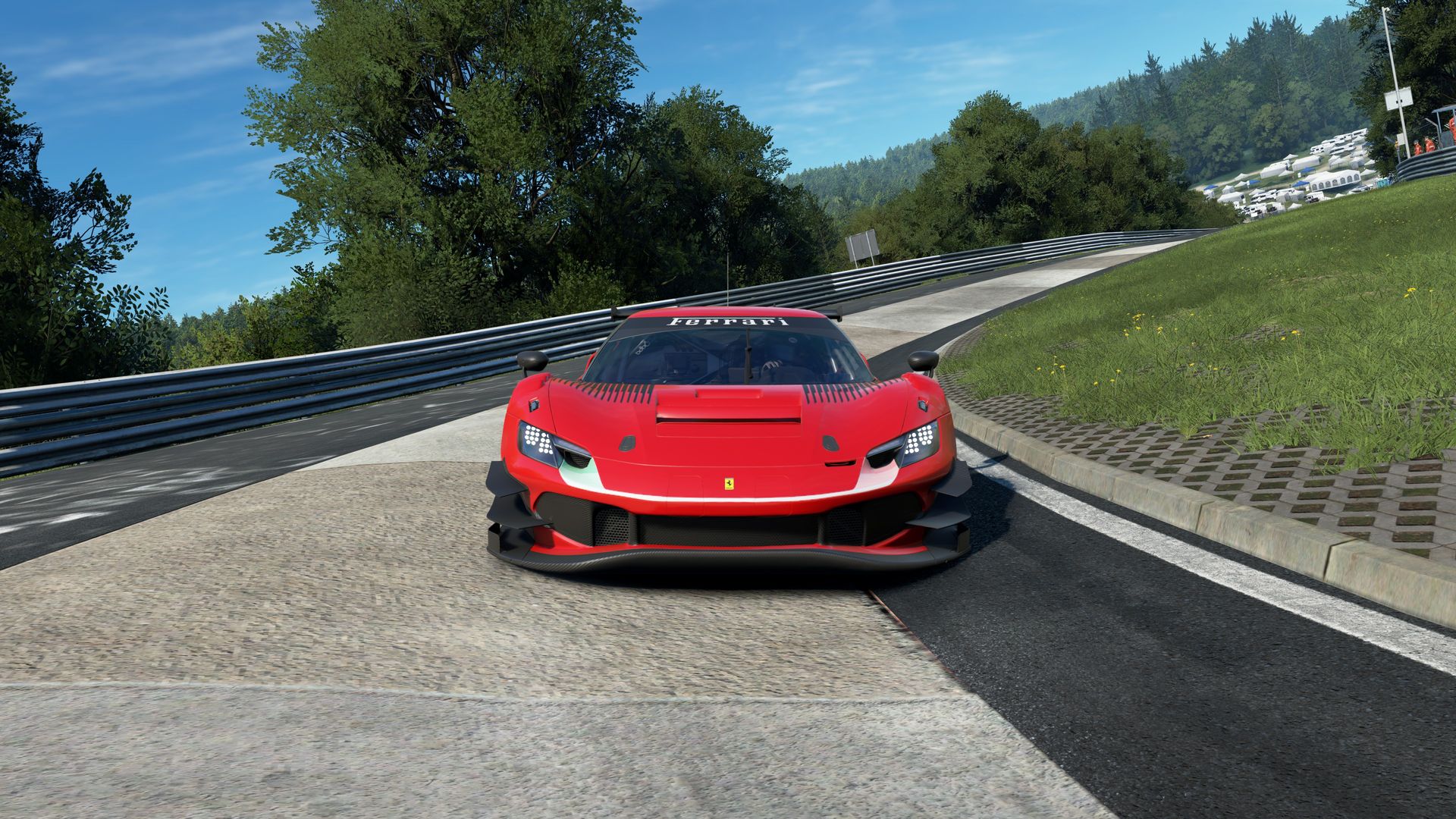
Brake bias decides what percentage of the pressure you apply with your foot goes to the front calipers and how much to the rear. 57% means 57 front, 43 rear.
It doesn't change total braking power. It changes who does the work. And because the two axles have different grip at any given moment, that split decides which one runs out first.
That's the whole theory. What matters is what it implies.
When you brake, the car's weight shifts forward. The front axle loads up and gains grip; the rear unloads and loses it. That's why every car brakes harder at the front than the rear.
But that transfer isn't constant: it peaks in the first instant of braking, when deceleration is highest, and falls as you shed speed and bleed off pressure to turn.
There's the problem this setting solves. A very forward bias is perfect for the initial peak but leaves the rear axle doing nothing at the end of the braking zone — exactly when you want the car to turn. A rearward bias helps it turn but can lock the rear at maximum deceleration, and that's a spin.
Your ideal value is the one that survives the peak without locking the rear and leaves as much work as possible to the rear axle in the final phase.
| Symptom | Likely cause | Fix |
|---|---|---|
| Inside front locks on turn-in | Bias too far forward | Move back 0.5-1% |
| Car won't turn while braking, runs wide | Bias too far forward | Move back |
| Rear steps out as you hit the brake | Bias too far rearward | Move forward |
| Car snaps as you release the brake while turning | Rearward bias, or diff on coast | Move forward first, then look at the diff |
| Gets nervous at the rear late in a stint | Less fuel, less rear load | Move forward as fuel burns off |
One important nuance: a lot of people confuse "won't turn under braking" with a setup understeer problem. If the car turns in fine when you brake gently and badly when you brake hard, it isn't the mechanical balance — it's the bias.
A method that takes twenty minutes:
Do it with a fuel load close to race trim, not with two litres in the tank. On an empty car you'll find a value that doesn't hold for the rest of the race.
The same car can want two points of difference between two circuits. The factors:
Which is why setup values you find online are a starting point and nothing more: they depend on the track, the fuel load and how you brake.
Almost every competition car lets you adjust bias from the wheel. It's one of the most useful tools available and the least used.
Practical tip: map two comfortable buttons and move it one click at a time. Big mid-race changes cost more than they give.
If you want to carry on from here, the next setting with the most impact is the differential, which decides how the car leaves a corner in the same way bias decides how it enters. And the technique that depends on bias most is trail braking.
That 57% of the brake pressure goes to the front axle and 43% to the rear. The higher the number, the further forward the bias.
Yes, at the cost of locking the fronts earlier and losing the ability to turn while braking. That's the central trade-off of this setting.
With less fuel the car is lighter, transfers less weight under braking and the rear ends up with less load. Moving bias forward compensates and stops the rear locking.
ABS prevents lock-ups but doesn't change how the work is split between axles. Bias set wrong with ABS shows up as a car that won't turn under braking, or a loose rear — you just don't see a locked wheel.
What it is, why it rotates the car, how to practise it and the mistakes that end in a spin.
Read →What each parameter does, what order to touch them in and how to spot clipping.
Read →How to break the 20.8 km into chunks, where the time really goes and the five decisive sections.
Read →The 24/7 is always open: jump in, move one click and compare in the same session.
 assettocorsaevo