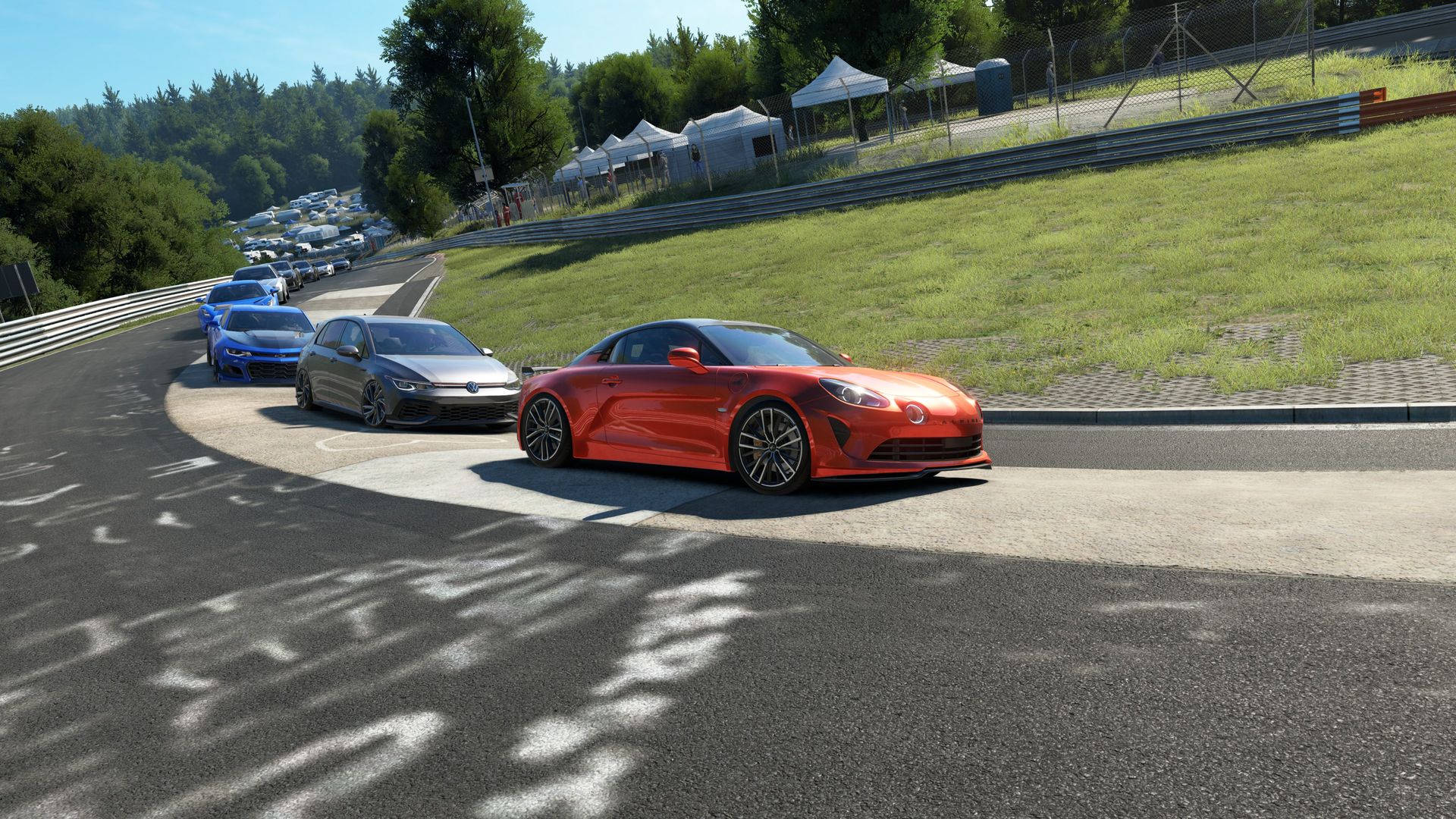
The first mistake with the Nordschleife is treating it like a circuit. It isn't: it's a closed mountain road twenty kilometres long. On a normal track you do eight laps and you know where everything goes. Here you can do fifty and still not know what's after one particular blind crest.
That changes the method. On a short circuit you improve by refining: brake ten metres later, use more kerb. Here you improve by removing doubt. Most of the time you're losing isn't from braking early — it's from lifting for half a second because you weren't sure what was coming.
Before you look at the clock, accept this: your first week isn't about being fast, it's about having no surprises. A driver who knows the track and drives smoothly is quicker than an aggressive one who hesitates four times a lap.
Nobody memorises 20 kilometres in one go. What people do memorise are blocks of a mile or so with a recognisable start and finish. The classic split is:
Take one block. Run it twenty times in practice mode until you can say out loud what's coming before you see it. Then move to the next. When you have two in a row, link them. That linking is what turns ten separate pieces into a lap.
It sounds slow. It is, by a distance, the fastest route. Learning the whole lap by driving whole laps means repeating the first five kilometres two hundred times and the last five almost never, because you arrive exhausted or you've already binned it.
A fast uphill right taken without seeing the exit, and immediately afterwards the ground drops away. Almost everyone lifts here because the car goes light. The time is in arriving with the car already straight and settled: if you get there with steering lock on and the car skipping, there's no way to stay flat. Fix it in the corner before, not in Flugplatz itself.
The "fox hole" descent compresses the car into the road at the bottom. It's frightening and that's why people lift. It's the section where an average driver gives away the most time. The key isn't bravery: it's having the car centred before the descent. Arrive crossed up and the compression pins you into the outside barrier.
A slow corner at the end of a slow section, and before the longest climb on the lap. Everything you gain on exit multiplies for the next three kilometres. It's one of the few places where sacrificing entry for a clean exit is clearly worth it.
The concrete banking. Two rules: enter slow and tight, and let the banking do the work. Almost everyone arrives fast, rides up onto the top edge, bounces and exits badly. The classic reference is to aim at the house visible on the left before the entry and drop the right front wheel into the concrete.
The jumps. Time is lost here through fear and cars are destroyed here through excess. The golden rule: don't change direction while the wheels are in the air. Straighten before the jump, land straight, turn afterwards.
The Nordschleife has a trap: it's so long that it's hard to tell whether a change actually made you quicker. These are the patterns that show up most when someone is stuck:
A fast lap and a thirty-minute stint aren't driven the same way. On a fast lap you can run minimal margin because you only have to survive once. In a stint, a mistake at kilometre 3 costs you twenty minutes.
Healthy stint pace is one to two seconds off your best lap, with a deliberate margin at the five or six blind points on the track. It's faster on average, because you finish.
Add another layer if you're sharing the track: closing speeds on the Nordschleife are enormous. Check your mirrors before the narrow sections, and if you're being caught, hold your line and lift a little on the straight. Jinking off into the grass is how half of all open-lapping accidents happen.
The temptation is the fastest thing you own. Bad idea. A very fast car forces you to process the track at a speed you can't yet follow, and you end up half-driving from memory, which is the worst way.
Start with something mid-powered, rear-wheel drive and honest. You want a car that warns you before it goes, not one that forgives everything. When you can do three laps in a row without incident and with similar times, move up a class.
Moving to a GT3 you'll notice two things: you brake far later, and the car demands a different kind of precision. Every visual braking reference changes — but the track itself, which is the expensive part to learn, you already have.
If you want something concrete, this works:
From there it's refinement. If the ceiling is your entry technique, the next step is trail braking, and the setting that controls it is brake bias.
Memorising the order of the corners takes ten to fifteen hours of wheel time if you do it section by section. Being genuinely quick takes months: the slow part isn't remembering where it goes, it's knowing how much speed each corner takes.
A slow, honest car. A GT3 hides your mistakes with grip and braking, and you end up learning references that don't transfer. A road car teaches you the track, which is the part that stays.
Useful for braking references and lines, not for pace. Watch short sections, then drive them yourself and compare. Watching whole laps without driving afterwards fixes nothing.
There's no settled official figure because it depends what counts as a corner. The usual reference is 73 left and 73 right, around 146, and many lists go past 170 if you count linked corners separately.
What it is, why it rotates the car, how to practise it and the mistakes that end in a spin.
Read →What each click does, how it shows up at the rear axle and how to find your value.
Read →What each parameter does, what order to touch them in and how to spot clipping.
Read →The 24/7 server rotates track weekly and the Nordschleife comes round often. No booking: jump in and drive.
 assettocorsaevo