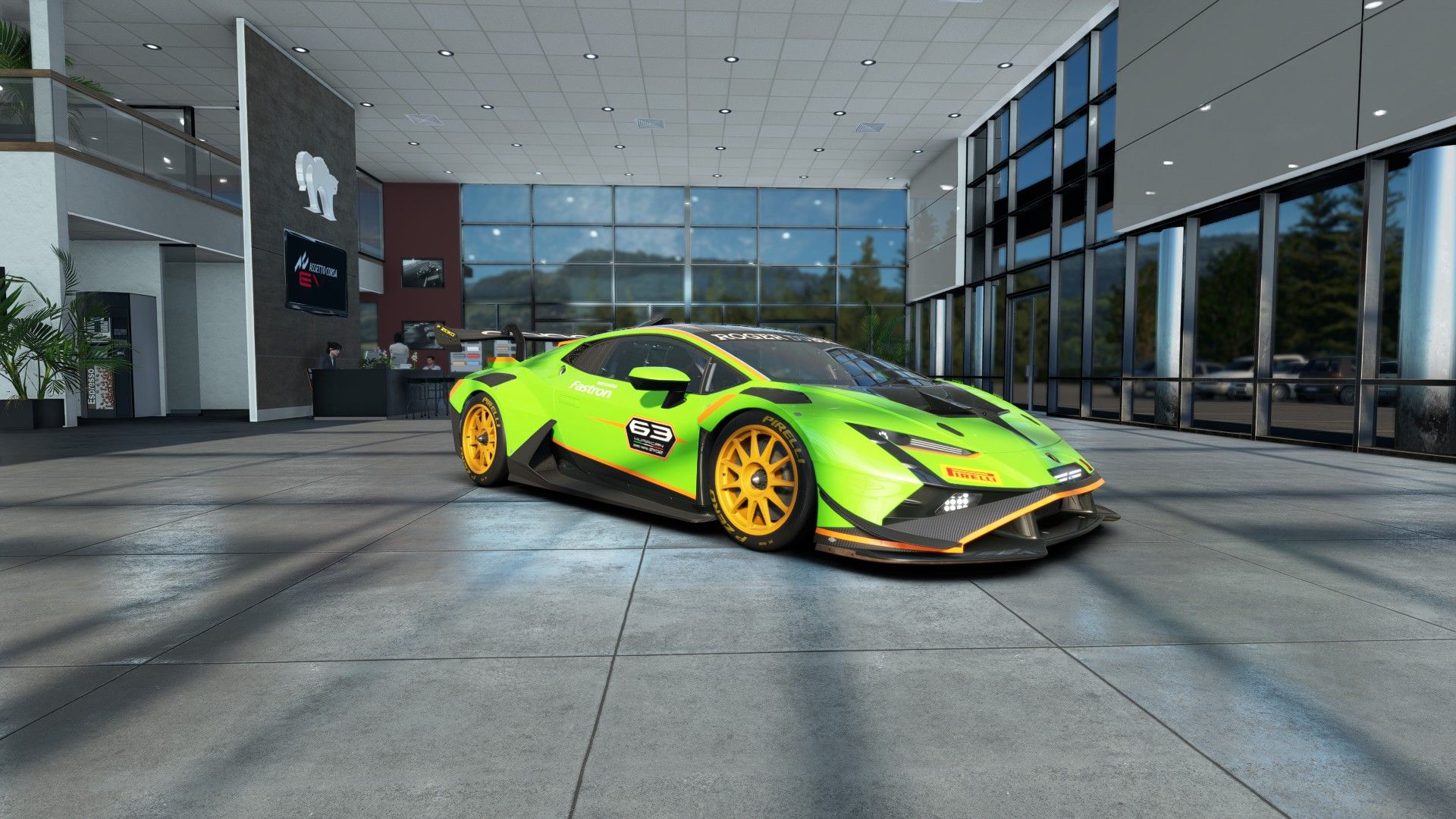
If you have a fixed budget, this split returns the most performance per pound:
The reason is simple: in sim racing you brake with your foot, not with the wheel. Braking points repeat well when the pedal responds to pressure rather than travel, and that's what a load cell gives you. A driver with a basic base and good pedals almost always beats one with an expensive base and spring pedals.
A small motor turns the wheel through gears. Cheap, and strong enough to feel the car. In exchange you feel the gear teeth as a constant coarseness and the fine detail is lost. It ages with play in the drivetrain.
The motor drives a belt. Smoother and quieter than gears, better detail, a bit more force. It's the classic middle step and still a sensible buy when budget rules.
The rim mounts straight onto the motor shaft: nothing sits between the motor and your hands. Consequences: zero backlash, instant response and a great deal of detail. Also more weight, more motor noise under load and the need for a serious mount.
There's now a category of entry-level direct drive with less torque than the professional units, and it has changed the maths: for what a good belt base used to cost you can have a small DD.
You can drive, learn tracks and enjoy it on a pad. Thousands of people do. What to know:
What's genuinely hard on a pad is fine braking and catching a slide as it starts. That's why moving to a wheel shows up more in consistency than in one fast lap.
This is where nearly everyone starts, and it's still a defensible buy. What to check:
With a base like this, properly configured, you can race a league and be competitive. The ceiling isn't the wheel.
What you genuinely gain moving to direct drive:
What you don't gain: you won't drop two seconds a lap. And be careful with torque: buying a 15 or 20 Nm base and running it at 30% strength is common, and means you paid for power you never use. For GT3s and touring cars, 5 to 8 Nm used properly is an excellent experience.
Non-negotiable requirement: a mount that doesn't flex. A powerful DD on a desk will move the desk, and the resulting feel is worse than a modest base bolted down properly.
There are two kinds of brake pedal:
The load cell is the single change that most improves repeatability of a braking point. Once your foot learns "this is 40 kg", you can reproduce it lap after lap even when you're tired.
If your budget only stretches to a basic base or good pedals, take the pedals.
Details that also help: metal rather than plastic pedals, adjustable positioning, and an analogue clutch if you like standing starts.
If the wheel moves while you turn it, you're receiving false information and tiring yourself out. Options, cheapest first:
And the part nobody mentions: your driving position. Seat at the right height, arms slightly bent, pedals aligned with your hips. A bad position tires you in twenty minutes and makes a long stint impossible, however expensive the gear.
| Budget | Priority | What to avoid |
|---|---|---|
| Minimum | A well-configured pad and a good seating position | 270° wheels and toy bundles |
| Tight | Second-hand gear or belt base + a solid desk | Spending it all on the base and keeping spring pedals |
| Mid | Load cell pedals + belt base | Direct drive without a rigid mount |
| Comfortable | Entry direct drive (5-8 Nm) + load cell pedals + rig | Buying extra torque "just in case" |
| No limit | Profile rig, DD, high-end pedals, triples or VR | Neglecting posture and cooling |
One idea that saves real money: most of this buys well second-hand. Rims and bases age slowly; what wears out is pedals and potentiometers.
Once it's built, the next job is configuring it. That's in the force feedback guide.
A little, but far less than people think. The big step in lap time comes from load cell pedals and a rigid rig. Direct drive mainly improves the information you receive and how tired you get in long stints.
Between 5 and 8 Nm is already more than most people use. Almost nobody runs their base at maximum: high values saturate and hide detail. Buying 15 Nm to drive at 40% strength is wasted money.
Yes — it's one of the best second-hand markets there is. Belt and gear bases age well; check for play in the shaft and that the pedal potentiometers aren't scratchy.
You can race and enjoy it, and some people are very quick on a pad. What's hard is consistency over long stints and fine brake control, which is where a wheel and good pedals make the difference.
What it is, why it rotates the car, how to practise it and the mistakes that end in a spin.
Read →What each click does, how it shows up at the rear axle and how to find your value.
Read →What each parameter does, what order to touch them in and how to spot clipping.
Read →Whatever you play with: the 24/7 server is open and asks for no minimum equipment.
 assettocorsaevo