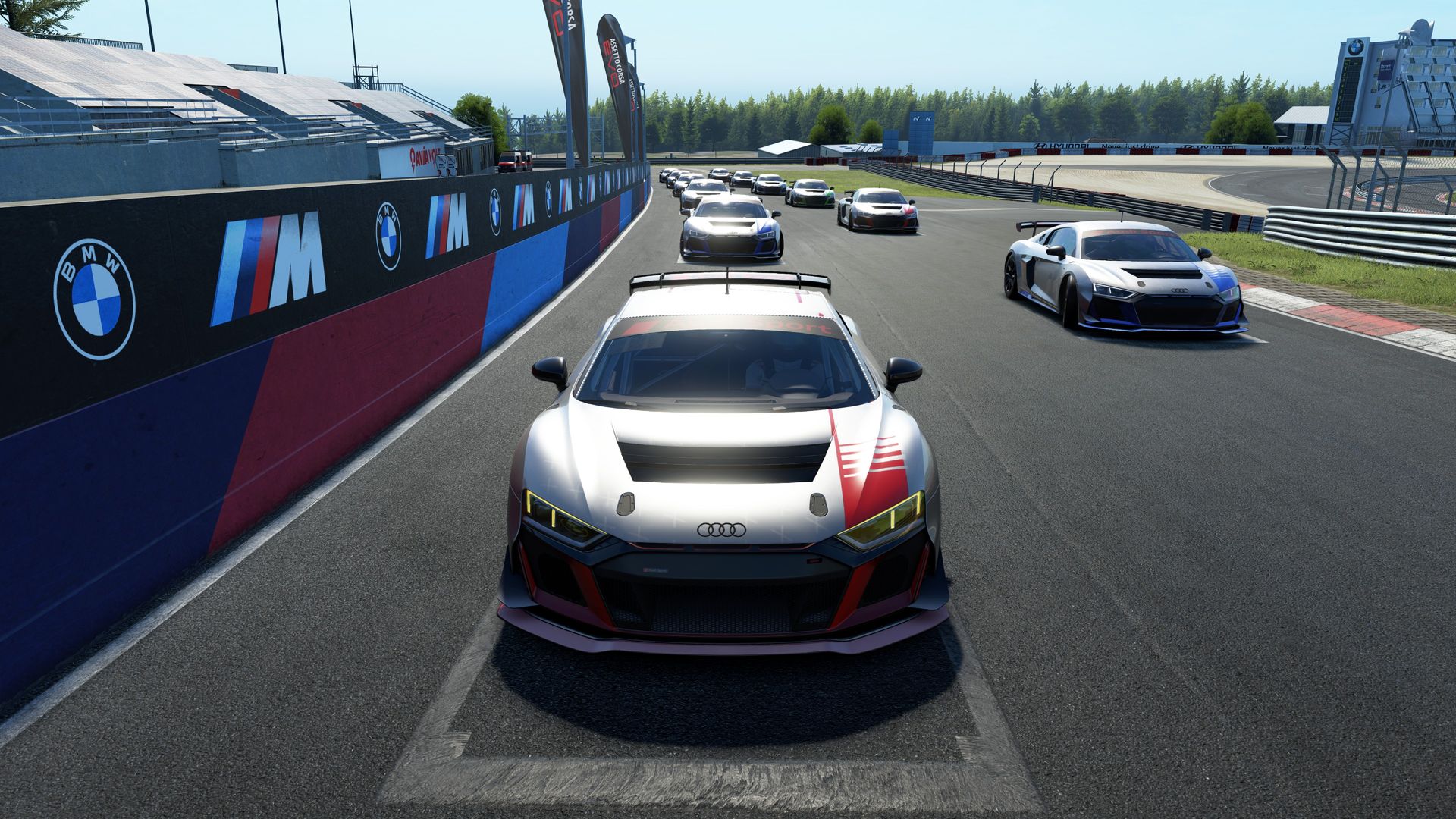
Before any technique there's a sum that decides 80% of overtakes: what you gain against what you're risking.
Gaining a place in a 30-minute race is worth a few points and a bit of pride. A contact in that same move can cost you the race, your rival's race and a penalty. Seen that way, the question stops being "can I get in there?" and becomes "can I get in there and come out the other side?".
That second half is what everyone skips. Getting down the inside under braking is easy: just brake later. Coming out of the corner pointing at the next straight, without having locked up and without having run the other car off, is not.
A clean overtake is built in three steps, and only the last one happens under braking.
If you're going to attack into turn 3, the work happens in turn 2. Sacrifice a little entry, prioritise traction on exit and get close on the straight. Arriving in the braking zone one car length back and carrying speed is what makes everything else possible.
Behind another car you lose downforce: the front axle grips less and the car pushes. On long straights that works for you, because the slipstream pulls you along. In fast corners it works against you. That's why the tow is for getting there, not for trying to go round the outside of a quick corner.
Position yourself on the inside before the other driver starts braking, not during. If your rival sees your nose in the inside mirror while still on the throttle, they'll leave room. If it appears once they're already turning, there's nothing they can do even if they want to.
Outside those four cases, attacking is usually a coin flip. In a fast corner, in a narrow section or over high kerbs, the odds of both of you ending up off are high.
The rule used by every serious rulebook, ours included, is easy to say and hard to apply in the heat of the moment:
If there's overlap at the moment of turn-in, both cars are entitled to a car's width.
In practice:
And one rule that prevents more incidents than any other: on lap one, be conservative. Half the retirements in an online race happen in the first thirty seconds, and almost none of those moves would have changed the final result.
Defending well is just as technical. What works:
What doesn't work: moving twice, closing the door once your rival is already alongside, or braking much earlier than usual to "surprise" them. That last one counts as erratic braking in most rulebooks and gets penalised.
There is always a moment when the move is no longer going to work. Recognising it is what separates a driver people trust from one who hands out damage.
Signs it's time to abort: you've locked up, your rival hasn't seen you and is still closing, or you're going to reach the apex at a speed that won't let you turn. In any of those three cases, open the wheel, let them go and reset. You lose a place. You'd have lost the race.
And if contact happens anyway, there's a habit that says a lot about a community: whoever is at fault lifts and gives the place back without being asked. It's what's expected in our races, and it's the difference between racing with people you know and racing in a random public lobby.
If you're new to racing online, start with the procedure for your first race.
The usual test is that, at the moment of turn-in, at least the front of your car is alongside the rival's helmet or mirror. Arrive later than that and the car ahead has no obligation to leave you room.
It depends on the relative position at turn-in. If the car behind hadn't established overlap and arrives with the wheels locked, it's theirs. If the car ahead closes on a car already alongside, it's theirs. Most rulebooks judge it that way, not by who hit whom.
One change of line to cover the inside is accepted in almost every rulebook. Two or more is not. And changing line once the rival is already alongside counts as dangerous driving.
Almost never. Finishing fifth scores; finishing in the gravel doesn't. The practical rule is that a move with less than a 70% chance of coming off is only worth it if you're fighting for the win on the last lap.
What it is, why it rotates the car, how to practise it and the mistakes that end in a spin.
Read →What each click does, how it shows up at the rear axle and how to find your value.
Read →What each parameter does, what order to touch them in and how to spot clipping.
Read →The 24/7 server is open practice: you can rehearse moves without a championship on the line.
 assettocorsaevo