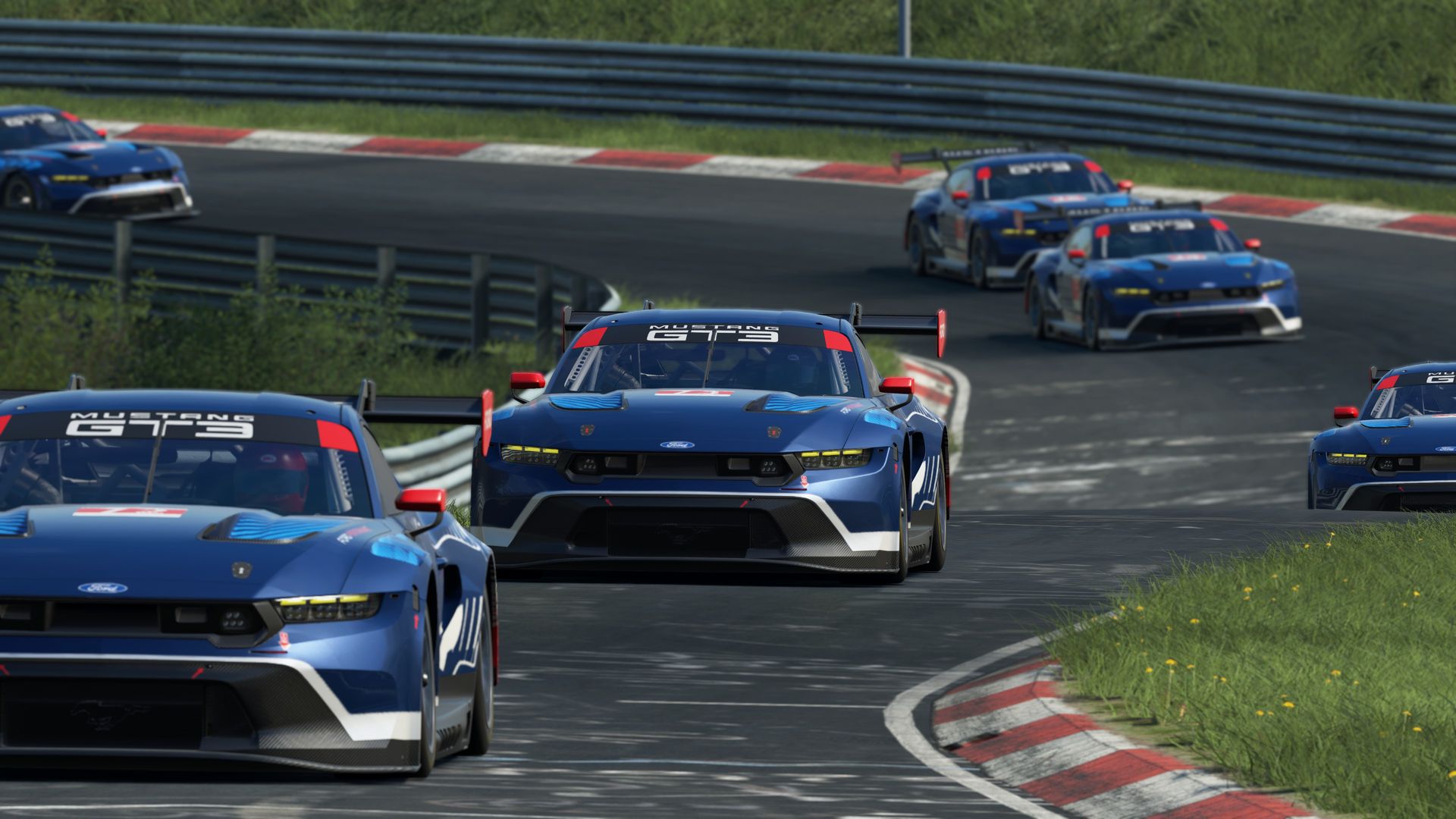
Five minutes of preparation saves you half the problems:
An organised race almost always has three phases:
In an open session like our 24/7 there's no qualifying and no grid: you go straight out on track. That's why it's the best place to start.
The pit lane has three rules that get broken constantly:
And on the way in: signal by lifting a little early and move to the pit side of the track in good time. Braking hard on the racing line to make the entry causes accidents.
Most incidents in an online race happen in the first thirty seconds. How not to be part of them:
Keep your distance to the car ahead, don't overtake and don't weave aggressively. Warm tyres and brakes with gentle bursts and short stops, without leaving your position.
You form up in two lines, at a constant speed, and nobody accelerates until the lights go out or the organiser gives the signal. Passing before the line is a penalty. Stay in your column: the other one isn't yours.
Gear engaged, clutch ready, revs where the car has traction. On the signal, release progressively. A long wheelspin doesn't give you a start — it takes it away.
One rule: leave a car's width. There's nothing to gain. Positions taken at turn one come back on their own within three laps if you have the pace, and they're gone for good if you end up in the gravel.
| Flag | Meaning | What you do |
|---|---|---|
| Yellow | Danger in that sector: stopped car, accident or debris | Lift, no overtaking until you're past |
| Double yellow | Track partly or fully blocked | Slow down properly and be ready to avoid or stop |
| Blue | A faster car is about to lap you | Hold your line and lift on the straight to let them by |
| White | Slow vehicle on track | Attention: it may be entering or leaving the pits |
| Green | End of the danger zone | You can race again |
| Black | A penalty or disqualification for you | Pit or comply as instructed |
| Chequered | End of race | Lift, don't brake hard and return to the pits off-line |
Blue causes the most confusion. It doesn't mean "get off into the grass": it means hold your line, be predictable and lift a little at the sensible place. The car lapping you is the one who has to execute the pass.
With that you can enter any race. Everything else — pace, setup, strategy — you learn by racing. If you want something with a real rulebook and stewards, there's the league, and if you'd rather ease in without pressure, the 24/7 is always open.
When you're ready to start fighting for places, read how to overtake without wrecking the race.
It doesn't matter, as long as you're predictable. Hold your line, don't jink out of the way and lift a little on the straight when they catch you. A slow, predictable driver isn't a problem; a fast, unpredictable one is.
Only if that race's rules require it. In short races, usually not. When a stop is mandatory it's announced beforehand, along with the window of laps you can take it in.
Stop if you can, check your mirrors and rejoin slowly and parallel to the track, never across it. If you're in a blind spot, wait. Rejoining sideways in front of someone is the quickest way to ruin two races.
No. In our races voice chat is optional and never a requirement to take part.
What it is, why it rotates the car, how to practise it and the mistakes that end in a spin.
Read →What each click does, how it shows up at the rear axle and how to find your value.
Read →What each parameter does, what order to touch them in and how to spot clipping.
Read →Before a race with a grid, do a few laps on the 24/7. It's open and there's nothing on the line.
 assettocorsaevo