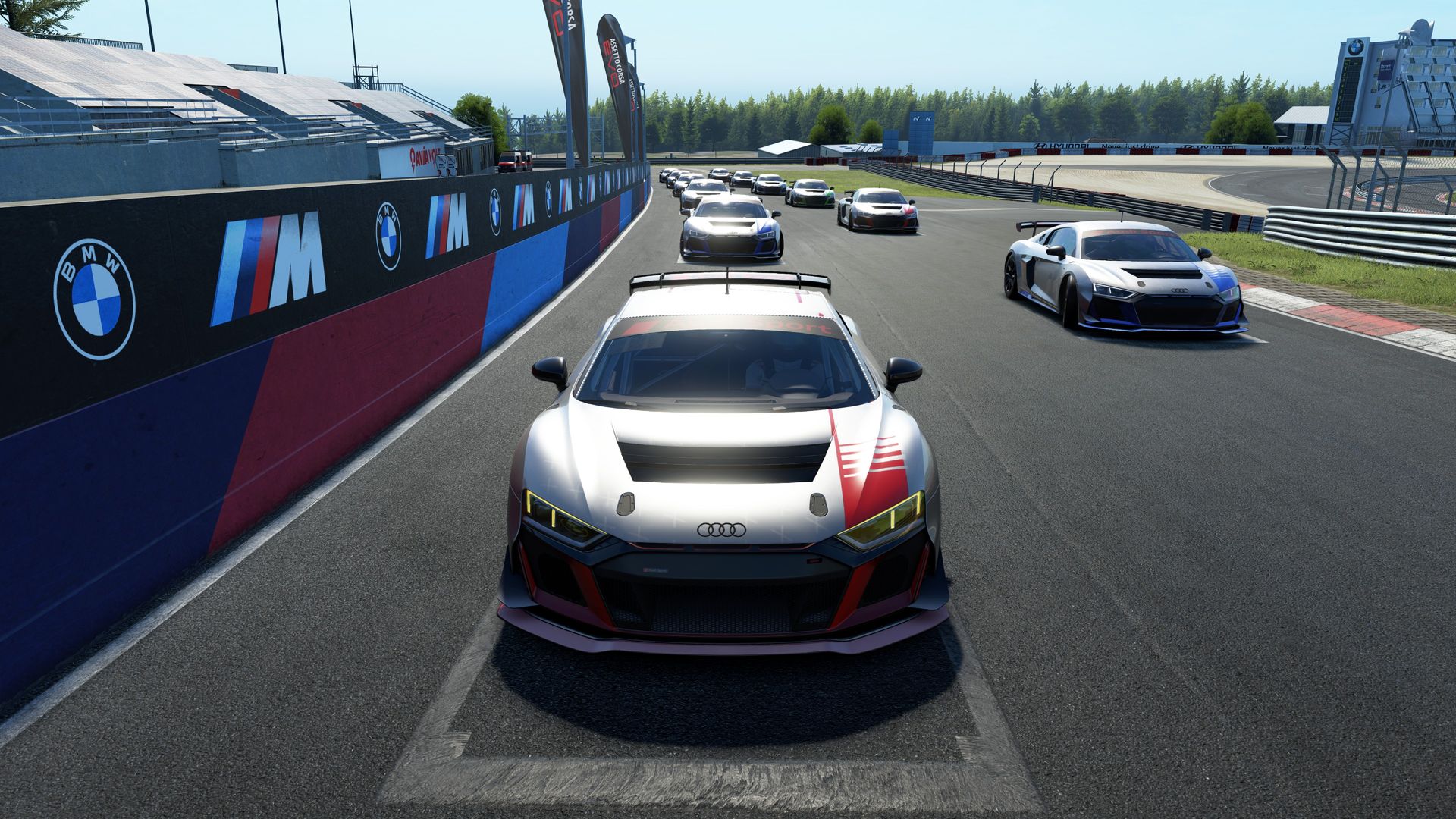
Almost all suspension tuning follows from a single principle: the axle that works harder grips less.
When the car loads up in a corner, weight transfers outwards. The stiffer an axle is, the faster and more concentrated that transfer becomes, and the sooner the outside tyre on that axle saturates.
Which gives you the rule that solves 80% of cases:
Everything else is detail about when that happens: on entry, mid-corner or on exit.
They carry the car's weight and control how far the suspension compresses.
By track: smooth tarmac and fast corners take stiff springs; bumpy surfaces, elevation change and high kerbs want soft.
And a nuance that gets forgotten: springs affect everything, including straight-line and braking behaviour. If you only want to change the balance in corners, the tool is the bar, not the spring.
They connect the two wheels on an axle. They only do something when one goes up and the other doesn't — that is, in corners. In a straight line, over a bump that affects both wheels equally, the bar does nothing.
That makes them the fine tool for balance:
It's the first thing to reach for when the problem is balance in a sustained corner and the car is fine in a straight line and under braking.
Careful in the wet: a stiff rear bar lifts the inside rear wheel, and with low grip that's a spin. In rain, soft bars.
They don't carry weight: they control how fast the suspension moves. That's why their effect shows up in transitions, not in sustained cornering.
The four usual adjustments:
Useful rule: if the problem appears on entry or when changing direction, look at dampers; if it appears mid-corner, look at springs and bars.
And a warning: dampers are where it's easiest to make the car worse while believing you're improving it. Small changes, one at a time.
Lower means a lower centre of gravity, less weight transfer and, on cars with a flat floor, more downforce. But if the car bottoms out or runs out of travel, it loses grip suddenly exactly where the load is highest.
The front-to-rear split matters too: lowering the nose more than the tail usually adds front downforce and helps the car turn.
The inclination of the wheel seen head-on. Negative camber — top of the wheel leaning inwards — makes the tyre sit flat against the road when the body rolls in a corner, exactly when it's needed most.
It's set by comparing inner against outer temperatures, exactly as explained in the tyre pressures article.
Working in the wrong order wastes whole afternoons. This one works:
And the usual discipline: one change, five laps, decide. Change two things and you learn nothing about either.
| Symptom | First thing to try |
|---|---|
| Won't turn on entry | Brake bias rearward, or softer front slow bump |
| Won't turn mid-corner | Stiffer rear bar or softer front bar |
| Won't turn on exit | Less differential lock on power |
| Rear steps out on entry | Brake bias forward; softer rear rebound |
| Rear steps out on throttle | Softer rear bar; less lock on power |
| Bounces over kerbs | Softer fast bump and a little more ride height |
| Unstable braking over bumps | Softer rear springs; less rebound |
| Slow to change direction | Stiffer springs and bars, carefully |
These are starting points, not truths. The same symptom can have two causes, which is why you change one thing and check.
The next setting with the most impact is the differential.
No. A very stiff car responds quickly but loses mechanical grip as soon as the surface isn't perfect. The optimum depends on the track: smooth tarmac takes stiff, bumpy tarmac wants soft.
The spring acts whenever that wheel moves. The bar only acts when the two wheels on an axle move differently — that is, in corners. That's why a bar changes balance without affecting bumps in a straight line.
Bump is the resistance to compressing; rebound is the resistance to extending again. Bump manages the impact; rebound manages how the weight settles afterwards.
Up to a point. Lowering improves the centre of gravity and the aero, but if it bottoms out or runs out of travel, the car becomes unpredictable exactly where the load is highest.
What it is, why it rotates the car, how to practise it and the mistakes that end in a spin.
Read →What each click does, how it shows up at the rear axle and how to find your value.
Read →What each parameter does, what order to touch them in and how to spot clipping.
Read →A setup is only proven by driving it. On the 24/7 you can compare pace with others the same day.
 assettocorsaevo