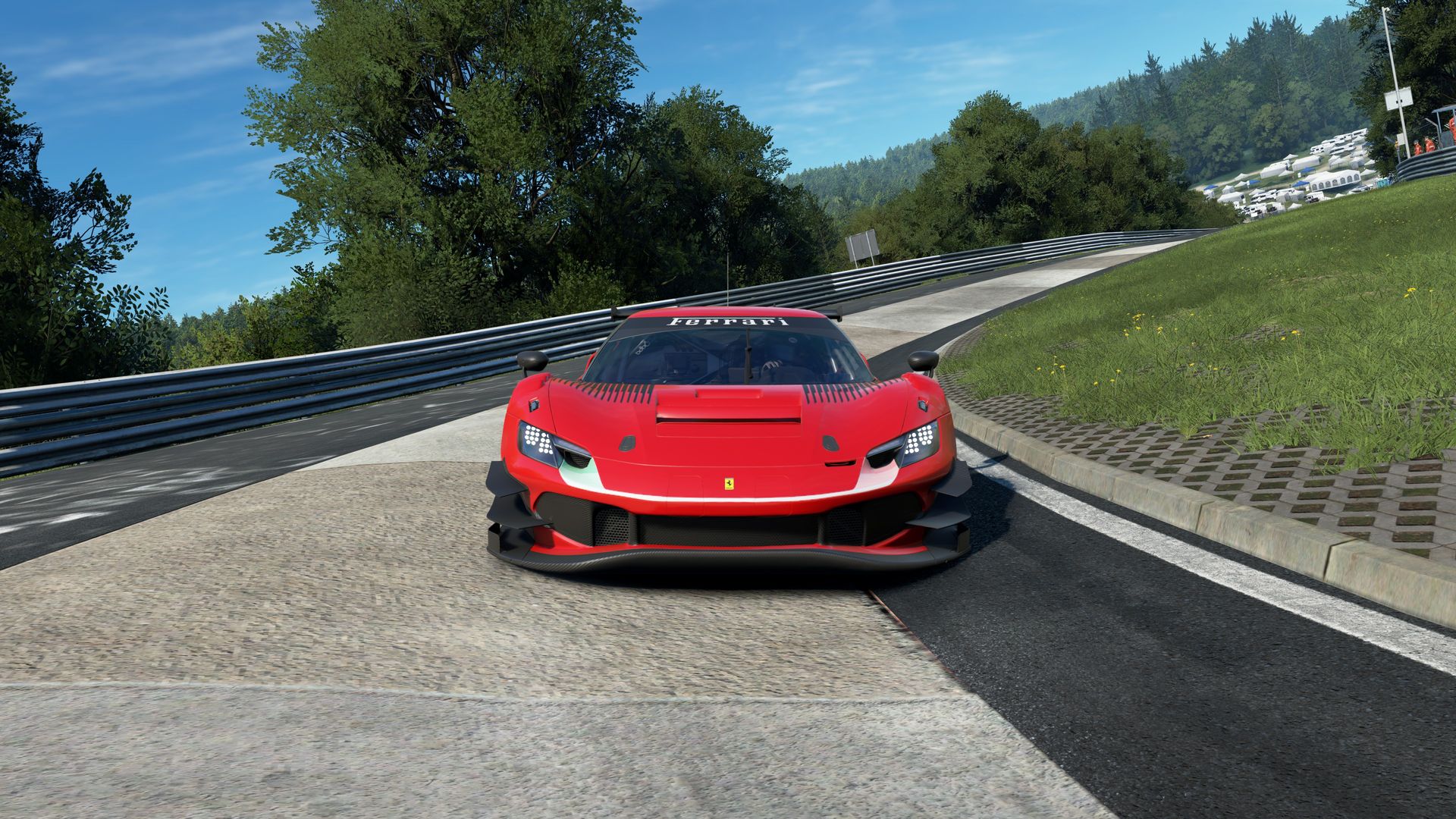
The catalogue is grouped into families that aren't just labels: each teaches something different and asks for a different style.
The usual mistake is always driving in the same family. Switching teaches you faster than repeating: a low-grip car forces you to carry corner speed, and one with huge brakes forces you to refine your foot.
Current sports cars and saloons: Abarth 695 Biposto, Alfa Romeo Giulia GTAm, Alpine A110S, Audi RS3 and RS 6, BMW M2, M3 E46 CSL, M4 CSL and M8 Competition, Caterham 485 CSR, Chevrolet Camaro ZL1, Dallara Stradale, Ferrari 296 GTB, Ferrari Daytona SP3, Hyundai i30 N, Lamborghini Huracán STO, Lotus Emira and Exige V6 Cup, Porsche 718 Cayman GT4 RS, Porsche 911 GT3 RS, Toyota GR86 and the Volkswagen Golf 8 GTI Clubsport and R.
What they teach: weight management. They carry more mass and more roll than a racing car, so transfers are obvious and punish abrupt inputs.
Who for: the best family to start in, and also the one that gives the closest racing between drivers of different levels.
The eighties and nineties: BMW M3 E30 Sport Evo, Ford Escort RS Cosworth, Honda S2000 AP1 and NSX-R, Lancia Delta HF Integrale Evoluzione II, Mazda MX-5 NA, Mercedes 190E 2.5-16 Evo II, Mini John Cooper S, Peugeot 205 T16, Porsche 911 Turbo 3.6 (964), Renault 5 GT Turbo and Toyota Supra MKIV.
What they teach: driving without a safety net. Low grip, modest brakes and, in several of them, turbos that arrive all at once. This is where you really learn throttle control.
Warning: the 911 Turbo 3.6, engine behind and turbo abrupt, is an accelerated masterclass in throttle management. Entertaining and treacherous in equal measure.
Alfa Romeo 75 Turbo Evoluzione, Audi Sport quattro, Ferrari 288 GTO, Lamborghini Countach LP5000 QV, Nissan Datsun 240Z, Toyota Sprinter Trueno AE86 and Volkswagen Golf GTI Mk1.
What they teach: everything depends on you. No ABS, no traction control and no downforce, so the only way to go fast is to be smooth and to anticipate.
Driving classics one evening a week improves your driving everywhere else. When you go back to a GT3, your feet are far better educated.
The broadest family: Audi R8 LMS GT3 Evo II and GT4 Evo, BMW M2 CS Racing and M4 GT3 Evo, Caterham Academy, Ferrari 296 GT3, 488 Challenge Evo, F2004 and SF-25, Ford Mustang GT3, Lamborghini Huracán ST EVO2, KTM X-Bow GT2 and GT4, Maserati GT2, Mazda MX-5 ND Cup, Mercedes-AMG GT2, Porsche 718 Cayman GT4 Clubsport, 911 GT2 RS Clubsport Evo, 911 GT3 Cup, 911 GT3 R Rennsport and Porsche 935. And from other eras, the Ferrari F40 LM and the Alfa Romeo Giulia Sprint GTA.
Inside it live very different things:
If you're settling on GT3, start with brake bias and the differential: those two move the most lap time.
| If you… | Take | Why |
|---|---|---|
| Are starting from zero | A mid-power modern road car | Warns before it goes and hides nothing |
| Already lap consistently | A one-make racer | Total parity: you win by driving |
| Want to compete seriously | GT4 then GT3 | Where the grids and rulebooks are |
| Want to learn to be smooth | A classic without aids | No electronics to save you |
| Want the biggest challenge | A single-seater | Another scale of braking and grip |
| Just want a good time | A youngtimer | Cars with character and lively racing |
A word of warning about lists: the catalogue grows with every update. This is today's snapshot and should be read as one.
Early access launched with around twenty and the catalogue has grown with each update past sixty. The final version is aiming at roughly a hundred, so any list is a snapshot of one moment.
A modern road car with moderate power and rear-wheel drive. It warns you before it goes, it doesn't hide your mistakes behind electronics, and what you learn transfers to everything else.
The community does create content, yes. It's worth knowing what to look for before installing anything: it's covered in the mods guide.
Perfectly, and they give very close racing because low grip levels the field. Some of the best sessions come from modest cars, not the fastest ones.
What it is, why it rotates the car, how to practise it and the mistakes that end in a spin.
Read →What each click does, how it shows up at the rear axle and how to find your value.
Read →What each parameter does, what order to touch them in and how to spot clipping.
Read →On the 24/7 you drive whatever you like. The best way to find the car you enjoy is to drive it.
 assettocorsaevo