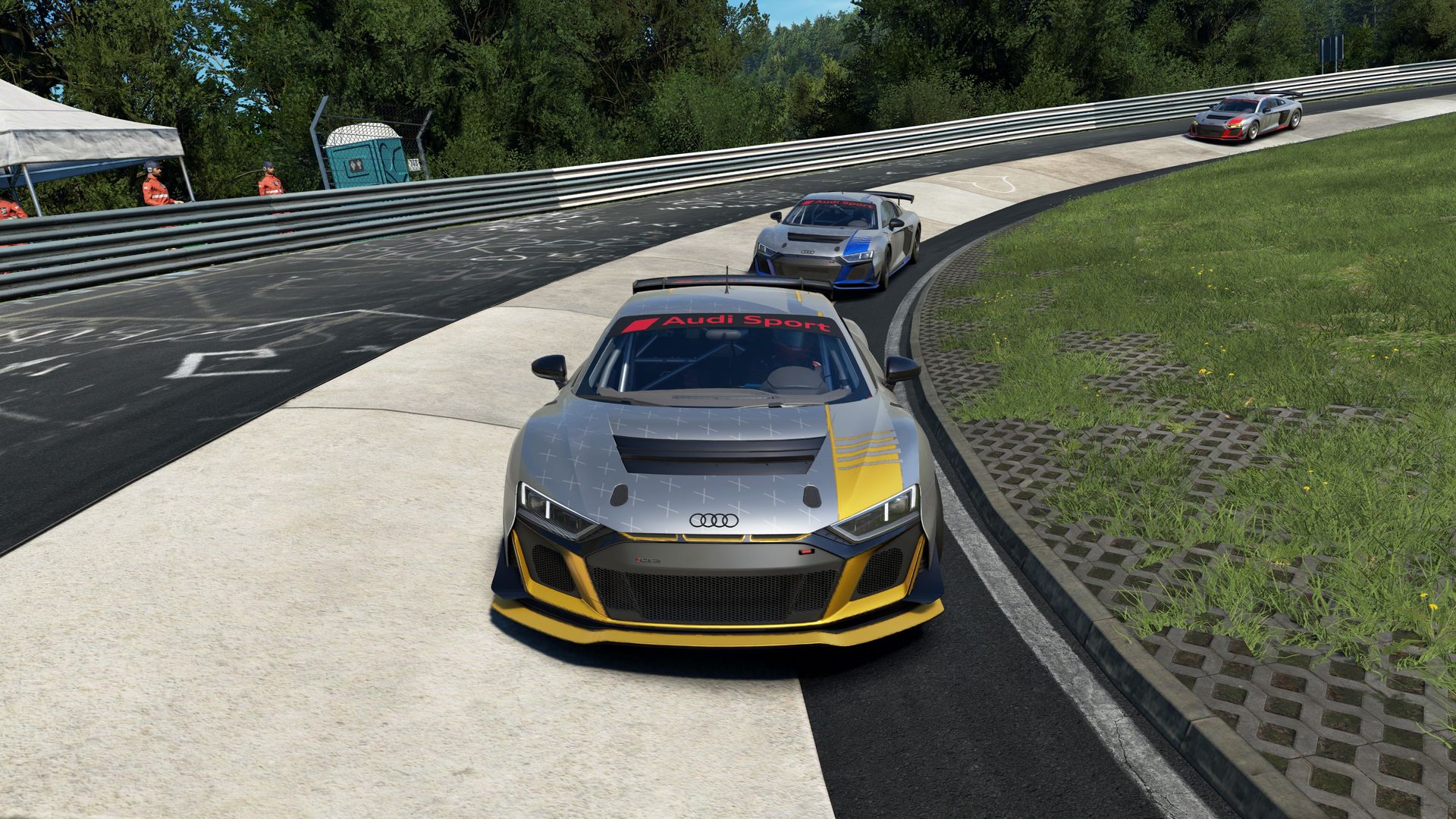
On a public server you join, drive and leave. There are no consequences: if somebody takes you out, nothing happens. In a league three things change everything:
That's what makes it possible to race a centimetre from another car for half an hour without it ending in disaster.
A league is announced with a fixed calendar: dates, tracks, car class and race length. That lets people plan and practise the next venue.
Entries are usually limited, for a practical reason: a 20-car grid with a rulebook works; a 40-car grid with no filter doesn't. Signing up normally means picking a car number and, if there is one, a team.
Many leagues charge a fee. It isn't arbitrary: it pays for the dedicated server, the stewards' time and the infrastructure. In ours, the monthly fee is also the filter that keeps out anyone turning up for one afternoon to mess about.
The most common format, and the one we use:
The grid is closed: everyone starts together from the position qualifying gave them. Nobody joins mid-race, which is the main source of chaos on open servers.
A decent rulebook fits on two pages and covers these points:
If a rulebook doesn't clearly say what happens when somebody takes you out, it isn't a rulebook: it's a list of good intentions.
The standard procedure, and the reason decisions hold up:
One detail that separates a serious league from an improvised one: stewards shouldn't be ruling on races in which they're personally fighting for position.
| Offence | Usual penalty |
|---|---|
| Repeated track limits | Warning, then 5 s |
| Pit lane speeding | Drive-through or 10 s |
| Light contact with no advantage | Warning |
| Contact costing the other driver a place | Give the place back or 5-10 s |
| Contact causing a retirement | 20 s to 30 s, or grid places next round |
| Dangerous driving or unsporting defence | 10 s and a disciplinary warning |
| Serious repeat offending | Exclusion from the round or the league |
The exact numbers vary, but the principle doesn't: the penalty should be proportionate to the harm done to the other driver, not to intent. In sim racing almost nobody takes someone out deliberately; the damage is the same either way.
You don't need to be fast. You need to be reliable. The short route:
For the detail of our format, prices and calendar, see the servers page. And if you'd rather run your own, you can list it in the community directory.
Before your first round, the first-race procedure covers the basics you'll be expected to know.
No. What's asked of you is consistency and cleanliness, not pace. A grid with two seconds a lap between drivers works perfectly well if everyone is predictable.
It depends on the rules. The usual thing is to give notice so it isn't counted as an unexplained absence and so the grid can be adjusted. Missing without warning is normally penalised in the standings.
Stewards appointed by the organisers, reviewing the replay from several camera angles. In serious leagues the decision is published with its reasoning, so anyone can see the standard applied.
In most leagues yes, within a short window and with a replay from your own point of view. What isn't accepted is arguing about it in chat during the race.
What it is, why it rotates the car, how to practise it and the mistakes that end in a spin.
Read →What each click does, how it shows up at the rear axle and how to find your value.
Read →What each parameter does, what order to touch them in and how to spot clipping.
Read →Closed grid, qualifying beforehand and stewards who review incidents on replay.
 assettocorsaevo