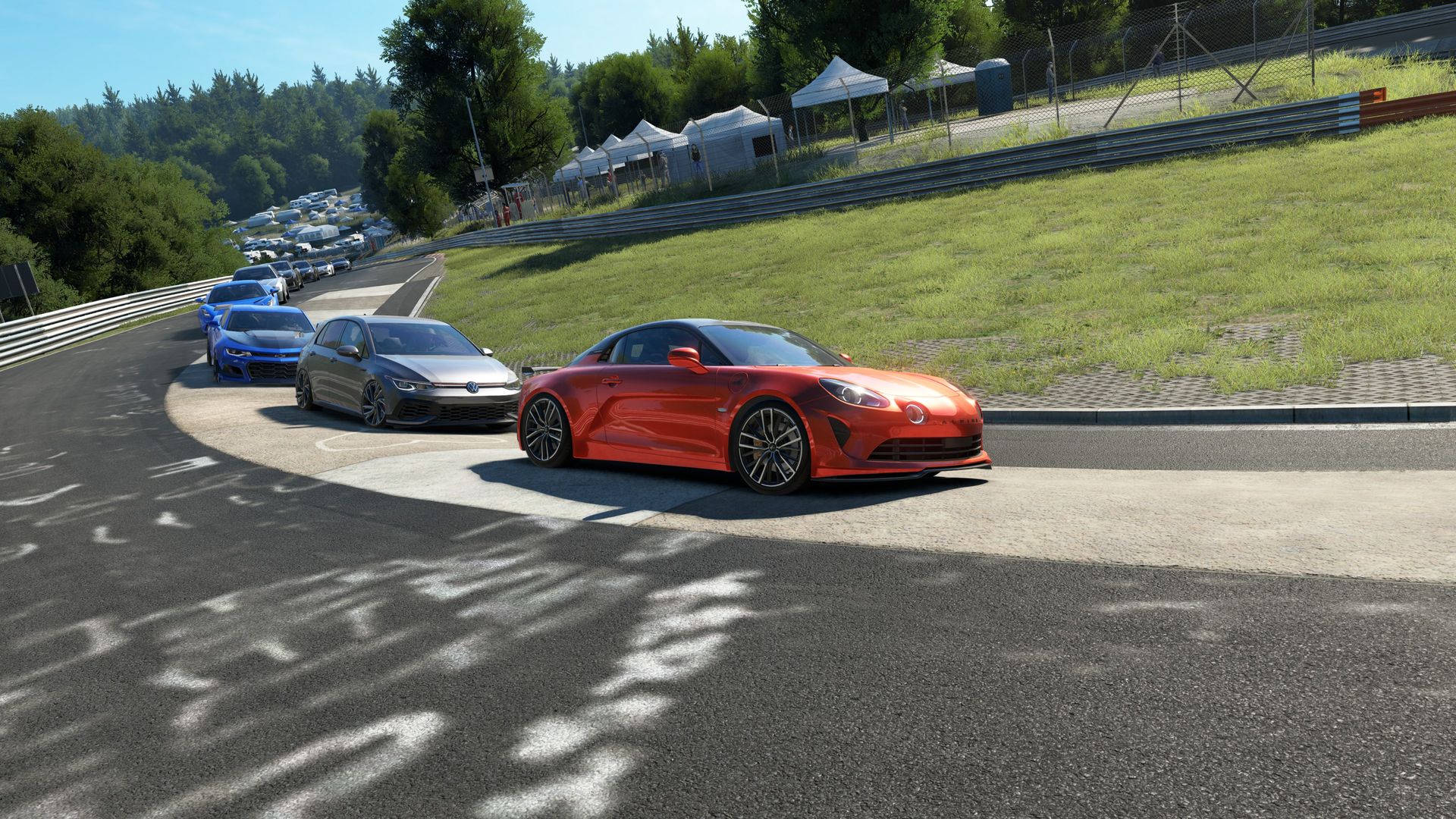
The most expensive mistake and the most invisible. When you're on the edge, your eyes drift to the bonnet and the immediate. And the closer you look, the more reactive your driving becomes: you reach each corner without having prepared it.
The fix: look at the apex before you get there, and at the exit before you touch the apex. The car goes where you look, literally: your hands follow your eyes without you thinking about it.
How to tell it's working: when you look far ahead, the wheel moves less and everything seems to happen more slowly. That feeling of calm is the sign.
The idea that braking late means going fast costs an enormous amount of time. What matters isn't when you start braking, but how you release.
A quick driver brakes very hard at first and bleeds off progressively to the apex. A slow one brakes late, at medium sustained pressure, and arrives past the apex: then they have to add lock and wait to accelerate.
The fix: brake earlier and harder, and release in a ramp. You almost always gain time by bringing the braking point forward. Developed fully in trail braking.
If the car won't turn, the instinctive reaction is more steering. And it's exactly the wrong thing: with the tyre already at its limit, more angle only adds sliding and heat.
The fix: when you feel understeer, open the wheel slightly. The tyre regains grip and the car starts to turn. It feels unnatural the first few times and it works every time.
On corner exit the car is still turning, so the rear tyre is already using part of its grip to hold the corner. Ask it for full power as well and it spins up.
The fix: progressive throttle, matched to the wheel unwinding. The mental rule: as the wheel returns to centre, the pedal goes down. Both together, never one before the other.
If you spin the wheels even when you're smooth, look at the differential: the setup may be working against you.
"Out, in, out" is a guide, not a law. Applied without thinking it costs time in two very common cases:
The fix: always ask what comes next. The right line for a corner depends on the following one, not on itself.
A three-tenths lift repeated ten times a lap is three seconds. And you don't notice, because it doesn't feel like a mistake — it feels like caution. The cure is knowing the track, not being brave.
If you aren't consistent, you can't evaluate a change: the spread between your own laps is bigger than the effect of the adjustment. Consistency first, setup second.
You get used to a car that doesn't exist in a race. Alternate with a real fuel load: the braking point and the balance change quite a bit.
One good lap in twenty doesn't win races and it misleads you about your real level. Five consecutive laps within three tenths are worth far more. The method is in how to set a fast lap.
Tired you drive worse, learn worse and make the mistakes you spent weeks correcting. Three one-hour sessions beat one four-hour session, and this isn't soft advice: it's what the clock says.
Record a lap and watch it from outside, or compare it with a faster driver in the same car. Every mistake in this article is visible to the naked eye on a replay.
Looking too close and lifting through doubt. Both are in your head rather than your hands, which is why they're so hard to spot: they don't feel like mistakes.
It helps, but you don't need it to start. Sector times and a replay watched from outside will catch almost everything on this list.
What it is, why it rotates the car, how to practise it and the mistakes that end in a spin.
Read →What each click does, how it shows up at the rear axle and how to find your value.
Read →What each parameter does, what order to touch them in and how to spot clipping.
Read →Driving behind someone quicker teaches you in ten laps what a hundred alone won't.
 assettocorsaevo