Assetto Corsa EVOassettocorsaevo.es
Home / Tracks / Spa-Francorchamps

Spa-Francorchamps

Seven kilometres through the Ardennes forest, with constant elevation change and weather that differs from one sector to the next. It's half the world's favourite circuit and the one that punishes disrespect hardest.

  • GP
  • Belgium
Trazado del circuito de Spa-Francorchamps
7,004Kilometres
19Corners
ClockwiseDirection
1921Opened
Difficulty to learnHigh
Average speedVery high
Physical demandHigh
Punishment for mistakesConsiderable
How much setup mattersHigh
Ease of overtakingVery high
How it drives

What you'll find

Spa-Francorchamps is, for a lot of people, the best circuit in the world, and that isn't an idle opinion: it brings together three things that almost never appear together. Brutal elevation change — there's over a hundred metres between the highest and lowest points of the lap — a length that lets the weather differ in every sector, and a design that rewards bravery without destroying anyone who gets it wrong once. In Assetto Corsa EVO you feel all of it from the first lap: the car compresses climbing Raidillon, goes light at Blanchimont, and asks for a setup that works nowhere else in the game.

Spa no perdona porque casi nunca vas recto. Desde La Source la pista cae en picado hacia Eau Rouge y Raidillon, un cambio de rasante que se sube a fondo si tienes el coche colocado y que te manda al muro si llegas cruzado. Arriba espera la recta de Kemmel, el mejor sitio del calendario para adelantar con rebufo.

The second sector is the opposite: Les Combes, Bruxelles and Pouhon ask for patience and a car that's stable in long-loaded corners. The third, with Blanchimont flat and the Bus Stop chicane at the end, decides the lap: that's where you lose the time you thought you'd gained earlier.

Where the time is

The three keys

01

Eau Rouge–Raidillon

Flat only if you arrive lined up. Any correction at the top costs you the whole straight.

02

Recta de Kemmel

El adelantamiento natural. Prepara el rebufo desde la salida de Raidillon, no en la mitad de la recta.

03

Pouhon

Apoyo doble a izquierdas, largo y ciego. Entrar pasado se paga con dos segundos de salida lenta.

Lap guide

Sector by sector

How the lap unfolds from start to finish, with the lines and the places where time is genuinely won and lost.

Trazado de Spa-FrancorchampsS1

Sector 1 · De La Source a Les Combes

The lap opens with the only genuinely slow corner on the track. La Source is a right-hand hairpin with dirty asphalt off the racing line, so the instinct to run wide for exit speed costs you: you lose grip exactly as you accelerate. You take it on the inside, brake less deep than you think, and come out straight, because what follows matters far more than the corner itself.

You drop towards Eau Rouge with the car unloading. The exact turn-in point is hard left, almost on the kerb, and you only go up flat if you arrive straight. Any steering correction in the compression unsettles you at the top, and at the top you're entering Raidillon blind. Then comes Kemmel, the long straight where most of the race's overtaking is decided: you pick up the tow from the exit of Raidillon, not halfway down the straight, or you'll arrive at Les Combes too late.

Trazado de Spa-FrancorchampsS2

Sector 2 · De Les Combes a Stavelot

Les Combes is a right-left chicane that kills the speed all at once. It's the most contested braking point on the circuit and where most first-lap contact happens, because you arrive in a pack and in the tow. You brake in a straight line and use the inside kerb without fear, but the exit kerb lifts the car: take it in full and you're in the gravel.

From there the track drops towards Bruxelles, a tight, blind, downhill left, and then opens into Pouhon: two very fast blind left-handers where the car loads up enormously. Pouhon is the corner that separates driver levels more than any other here. Entering two km/h too fast won't put you off the track, but it forces you to lift on exit and you drag the mistake all the way to Fagnes. The last stretch, Campus and Stavelot, is about traction: how you apply the throttle matters, not how you brake.

Trazado de Spa-FrancorchampsS3

Sector 3 · De Blanchimont al Bus Stop

Blanchimont is a very long left taken flat in a GT3, and it commands respect for the first few laps because the wall is right there. There's no technique to it: there's trust in your downforce and in the car staying planted. If your setup is nervous, this is where you find out.

The lap ends at the Bus Stop, the slowest chicane on the circuit. It's the last place to overtake and the most tempting place to overshoot: you arrive very fast and the braking zone is short. The kerbs are tall and unsettle the car, so it pays to take it cleanly and prioritise the exit onto the straight, because from there you go straight to La Source with someone glued to your gearbox.

Glossary

Every corner, one by one

What each corner is called, what type it is and what it asks of you.

NºNameTypeWhat it asks for
1La SourceHorquilla lentaInside line in, straight out: what matters is traction towards Eau Rouge.
2-4Eau Rouge–RaidillonFast compressionLlegar recto al fondo. Sin correcciones de volante en la subida.
5KemmelRectaRebufo desde la salida de Raidillon, no a mitad de recta.
6-7Les CombesChicane derecha-izquierdaFrenar recto, pisar el piano de entrada, evitar el de salida.
8MalmedyMedium rightSalida limpia; condiciona la bajada a Bruxelles.
9BruxellesIzquierda cerrada ciegaDownhill braking with a light rear end.
10Speaker's CornerFast rightSe pasa casi de largo: apoyo corto y a por Pouhon.
11PouhonFast double leftCiega y larga. Entrar justo o pagas la salida entera.
12-13FagnesFast chicaneCambio de apoyo seco. Coche estable o pierdes el tren trasero.
14Campus (Stavelot)Medium rightA traction corner: how you apply the throttle decides it.
15Curve Paul FrèreFast leftA fondo con carga. Prepara la entrada a Blanchimont.
16BlanchimontVery fast leftA fondo con GT3. Pura confianza en el reglaje.
17-18Bus StopChicane lentaÚltimo adelantamiento. Pianos altos: tomarla limpia.
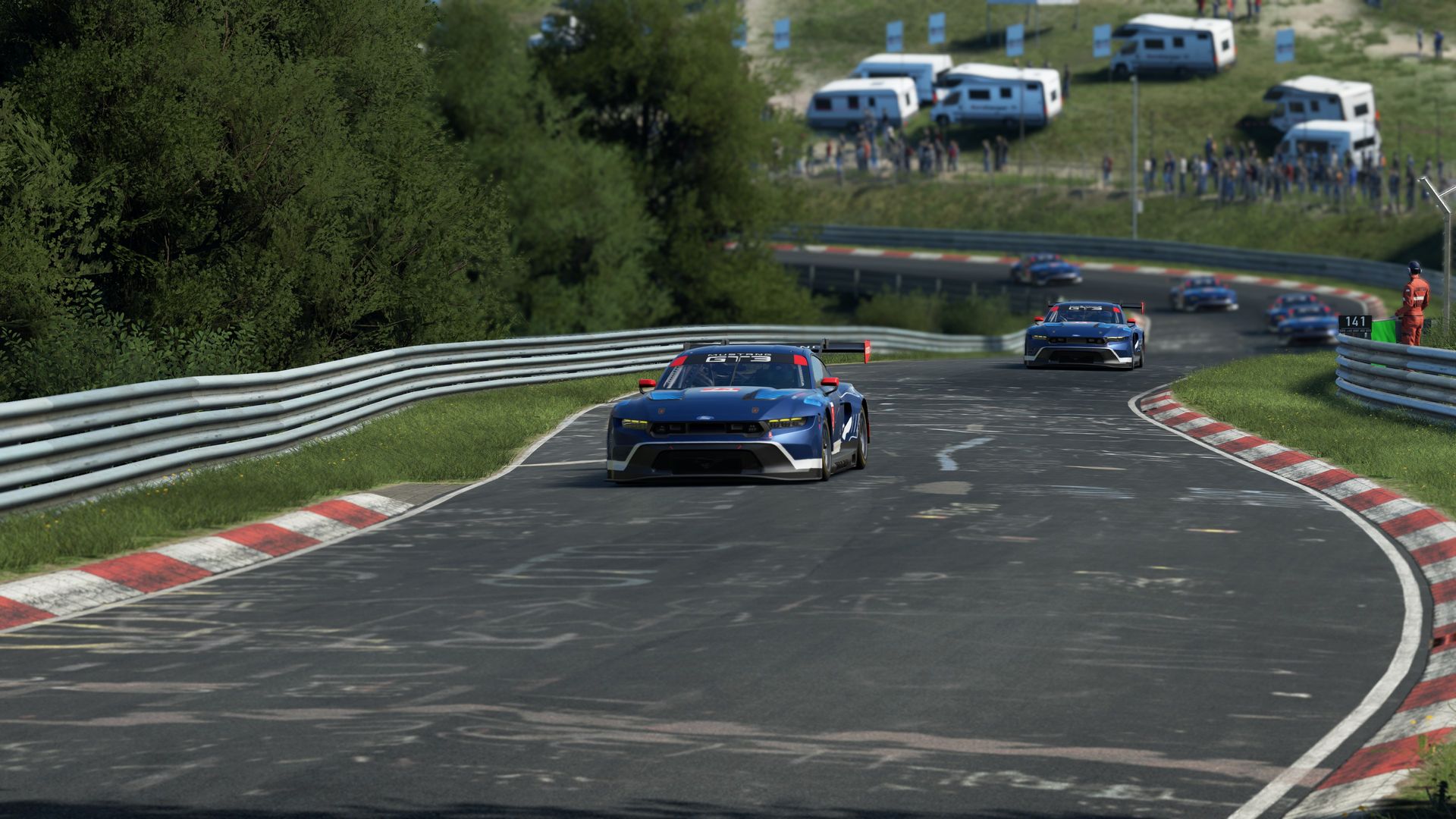
A Mustang GT3 with the crowd behind
Community

Spa-Francorchamps

Taken at Nordschleife · A Mustang GT3 with the crowd behind

Kemmel no se gana en la recta: se gana en la salida de Raidillon, trescientos metros antes de que nadie piense en adelantar.
Setup

How to set the car up

Spa asks for an unusual compromise: you need downforce for Pouhon, Blanchimont and Raidillon, but every point of it costs you speed on Kemmel, which is nearly two kilometres flat out. Most people end up with slightly more wing than they'd run at Monza but a good deal less than at a slow circuit.

The suspension can't be too stiff: the Eau Rouge compression and the kerbs at Les Combes and the Bus Stop need the car to absorb. A very stiff car bounces on the climb and loses the rear exactly where there's no run-off. And with a full tank, in a long race, the effect multiplies.

The brakes suffer less than at other tracks because there are few heavy stops, but the ones there are last a long time: La Source, Les Combes and the Bus Stop. Brake bias usually sits slightly further back than normal to avoid locking the fronts in the downhill sections.

Cars

Which car to bring here

GT3

The category that makes the most sense here. They have enough downforce to take Raidillon flat and Blanchimont without lifting, and enough weight for the long stops at Les Combes and the Bus Stop to have some margin. If you're learning the circuit, start with a GT3.

GT4 y turismos

They're slower, which makes the track easier to read: Eau Rouge stops being frightening and Pouhon can be taken with margin. In exchange, the lack of power turns Kemmel into an endless straight where the tow decides everything. They're ideal for your first laps.

Coches de calle potentes

This is where Spa turns treacherous. You have top speed to spare but little downforce, so Raidillon and Blanchimont stop being confidence corners and become respect corners. This is where most people crash trying to copy what they do in a GT3.

Mistakes

What almost everyone gets wrong

  1. Abrirse en La Source. Off the racing line the asphalt is dirty and has less grip. You gain two metres on entry and lose all your traction towards Eau Rouge, which is the traction that counts for the Kemmel straight.
  2. Corregir en Eau Rouge. If you arrive out of shape, the natural reaction is to correct halfway through the compression. That's exactly what unsettles the car at the top. Better to lift slightly earlier and go up straight than to correct inside it.
  3. Coger el rebufo tarde. Kemmel is won at the exit of Raidillon. If you wait until you're on the straight to tuck in behind, you've already lost half the benefit.
  4. Pisar el piano de salida de Les Combes. El de entrada es plano y se pisa entero. El de salida levanta el coche y te manda a la grava con la rueda de dentro girando en el aire.
  5. Entrar pasado en Pouhon. It doesn't put you off the track, which is why it's so treacherous: you think you got it right, but you had to lift on exit and you arrive at Fagnes slowly. You lose tenths without noticing.
  6. Frenar tarde en el Bus Stop. It's the last place to overtake and the temptation is enormous. Overshooting there means losing the position and arriving badly at La Source, with the car behind glued to you all the way up the hill.
Practice

How to learn it without frustration

Spa is learned by sector, not by complete laps. Seven kilometres is too much to memorise in one go, and running full laps from the start only means repeating the same mistakes in the same corners without fixing any of them.

Start with sector 2, which hides the most time. Do short runs focusing only on Les Combes, Bruxelles and Pouhon until the exit of Pouhon comes out clean three times in a row. When it does, add sector 3, the fastest and the one that needs the most confidence. Leave sector 1 for last: it's the shortest and the easiest to absorb.

Once you have all three, do long runs of ten or fifteen laps on race fuel. Spa changes a lot with a full tank: the car compresses more at Eau Rouge and Blanchimont stops being free. Anyone who has only practised single laps finds this out in the race, and too late.

Conditions

Rain and night

In the wet

It's the circuit where rain rules more than anywhere on the calendar, because it rains by sector. You can have a dry first sector and a flooded Pouhon, and choosing tyres with that information is half the race. Raidillon in the wet stops being a flat-out climb and you have to lift before the compression: it's the site of the most serious accidents here.

At night

On a track this long, the woodland section between Pouhon and Stavelot goes very dark and the visual references disappear. You drive from memory and off the kerbs. The entry to Blanchimont, imposing enough in daylight, forces you at night to trust your marker rather than what you can see.

Reality and the sim

From the real circuit to Assetto Corsa EVO

How the real circuit gets into the game

Assetto Corsa EVO rebuilds its circuits by combining laser scanning and photogrammetry. The laser scan travels the lap measuring millions of points a second and returns the real surface to millimetre precision: not just where the track goes, but how far it dips at each point, where the bumps are, exactly how steeply Raidillon climbs and how tall every kerb is. Photogrammetry handles the surroundings, the buildings and the objects around the track, which is what gives you your visual references.

That difference matters more than it sounds. On a circuit modelled by eye from drawings, the corners are where they should be but the ground is smooth and false; on a scanned one, the car moves because real asphalt isn't smooth. At Spa you notice it exactly where it hurts: in the Eau Rouge compression, where the gradient changes twice, and on the exit of Stavelot, where the surface has undulations that unsettle the car if you're on the limit.

What carries over well from the real world

The visual references work. If you learn to brake at the 100-metre board for Les Combes in the sim, that board is in the same place in reality, and vice versa. Turn-in points, kerbs, track width and crest changes transfer almost one hundred per cent, and that's why real teams use simulators so their drivers arrive at an unfamiliar circuit already knowing it.

The racing line travels well too. The line that's fast at the real Spa — running just wide enough at La Source, hugging the inside at Pouhon, sacrificing the Bus Stop entry for a better exit — is the same line that's fast in the game, because the geometry is the same. And the pecking order of difficulty holds: the corners that command respect in reality are the ones that command respect here.

What a simulator can't reproduce

First, G-forces. In the real Eau Rouge the body is crushed into the seat at over 4 G in the compression, and that load is information: the driver feels how much grip is left. At home that information doesn't exist, which is why people push closer to the limit in a sim than they would in reality. It isn't that the game is easier: it's that the physical warning is missing.

Second, peripheral vision and the sense of risk. On a single monitor you see a narrow window of the world, so fast corners feel slower than they are and walls feel further away. Triple screens or a VR headset get much closer, especially at Blanchimont, where you suddenly understand why real drivers talk about that corner with respect.

And third, consequences. In reality nobody goes up Raidillon two km/h faster each lap until they crash. In a sim they do, and that method — the one that makes you fast at home — is precisely the one you can't apply on a real track.

Usar el simulador para aprender el circuito de verdad

If you ever get to drive at Spa, the game is the best preparation there is. Arrive knowing the order of the corners, the turn-in points and which way the track falls, and your first day on track will be spent adapting to the car rather than memorising where to go. It's worth practising in the sim with the same type of car you'll actually drive: learning the track in a GT3 and turning up in a road car with no downforce is asking for a fright at Raidillon.

It works in reverse too. Anyone who has been to Spa recognises the real gradient in the game, and that changes how they drive: they stop treating Eau Rouge as a video-game corner and start respecting the compression. It's the best way to stop going fast by repetition and start going fast by understanding what the car is doing.

Data

Track data

Official nameCircuit de Spa-Francorchamps
LocationStavelot, province of Liège, Belgium
Length7,004 km
Corners19 (9 a derechas, 10 a izquierdas)
DirectionClockwise
DesnivelOver 100 metres between the highest and lowest points
Opened1921 (trazado original de casi 15 km)
Trazado actualDesde 1979, con reformas posteriores en el Bus Stop y las escapatorias
Main racesBelgian Grand Prix, Spa 24 Hours (GT3), World Endurance Championship
In Assetto Corsa EVOLaser scanned, full GP layout
Pouhon doesn't put you off the track. It just lets you believe you got it right while you lose three tenths a lap.
History

Where it comes from

The original 1921 layout was a triangle of public roads nearly 15 km long between Francorchamps, Malmedy and Stavelot. It was cut in half in 1979 after years of serious accidents, and the spirit of that old circuit survives: it's still fast, still long, still with the forest right up against the track.

It hosts the Belgian Grand Prix and the Spa 24 Hours, one of the great GT3 endurance events. It's the circuit where the weather rules: it's not unusual for it to rain in one sector while another stays dry.

History

The moments that made it

1966

The Belgian Grand Prix deluge

Rain caught the field out on the first lap of the old, nearly 15 km layout. Half the grid went off and Jackie Stewart was trapped in his car for minutes. That accident marked the beginning of his campaign for safety in motor racing.

1979

El circuito se parte en dos

After years of pressure over the danger of the long layout, Spa was cut to today's seven kilometres. The run through Malmedy and Masta was abandoned and the new section between Les Combes and Stavelot was built — the one raced today.

1992

El primer podio de Schumacher... y su primera victoria

Spa is where Michael Schumacher made his debut in 1991 and where he won his first race a year later. It would become the track most associated with him, with six wins.

2021

The shortest race in history

The Belgian Grand Prix was declared run after two laps behind the safety car, in rain that made racing impossible. Half points were awarded without a single racing lap being completed.

In person

Visiting the real circuit

Spa-Francorchamps is a permanent circuit and you can't drive it freely like the Nordschleife, but it runs track days open to private drivers for much of the year. You book them by session, normally with specific insurance and a technical check on arrival, and sessions are split by level so a road car and a race car don't share the track.

The circuit sits in the heart of the Ardennes, about forty minutes from Liège and a little over two hours from Brussels. You can drive much of the old layout, because those roads are still public: the Masta straight and the run through Burnenville are ordinary main road today, speed limits and all.

To see it racing, the two big dates are the Belgian Grand Prix in summer and the Spa 24 Hours, usually held in late June or early July. The latter is far more affordable and gives access to parts of the circuit that are closed on a Formula 1 weekend. [Confirm dates and prices on the circuit's official website before booking a trip.]

Data

Trivia

Questions

Frequently asked

How long is the Spa-Francorchamps circuit?

The current layout is 7.004 kilometres, which makes it the longest permanent circuit on the Formula 1 calendar and one of the longest available in Assetto Corsa EVO.

Is Eau Rouge flat out?

In a modern GT3 with the car properly placed, yes. The key isn't throttle bravery but trajectory: you have to arrive straight at the bottom of the compression. If you enter out of shape or correct the wheel halfway up, you have to lift.

Where do you overtake at Spa?

The natural place is the end of the Kemmel straight, braking into Les Combes. The second is the Bus Stop at the end of the lap. With a long tow, the exit of Blanchimont also lets you get alongside.

How much downforce should you run?

Less than at a twisty circuit but more than at Monza. The practical test is your top speed at the end of Kemmel: if people pass you in the tow with no answer, you're carrying too much wing.

Why does it rain so much at Spa?

The circuit sits in the middle of the Ardennes, an area with a damp, changeable microclimate. At seven kilometres long, it's normal for one part of the lap to be wet and another dry at the same time.

Which is the hardest corner at Spa?

Pouhon. It's a fast, blind double left with no clear braking references, and it's where most time is lost without you realising.

Gallery

Community shots

Screenshots taken by the community in Assetto Corsa EVO. Each caption says which circuit it's from.

A Mustang GT3 with the crowd behind
NordschleifeA Mustang GT3 with the crowd behind
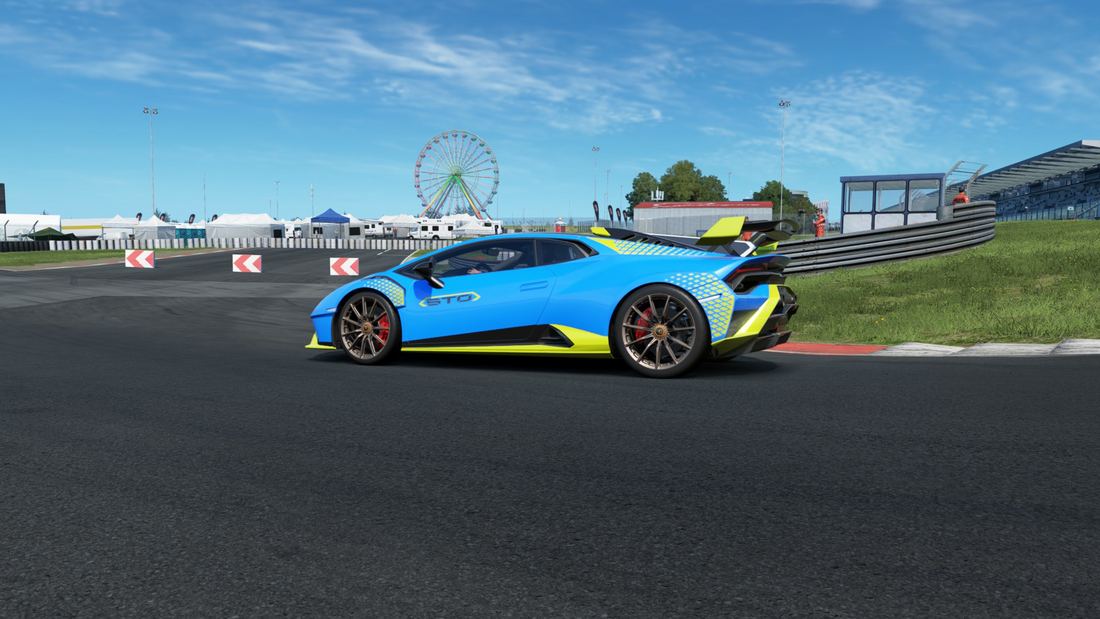
A Huracán STO with the big wheel behind
Nürburgring GPA Huracán STO with the big wheel behind
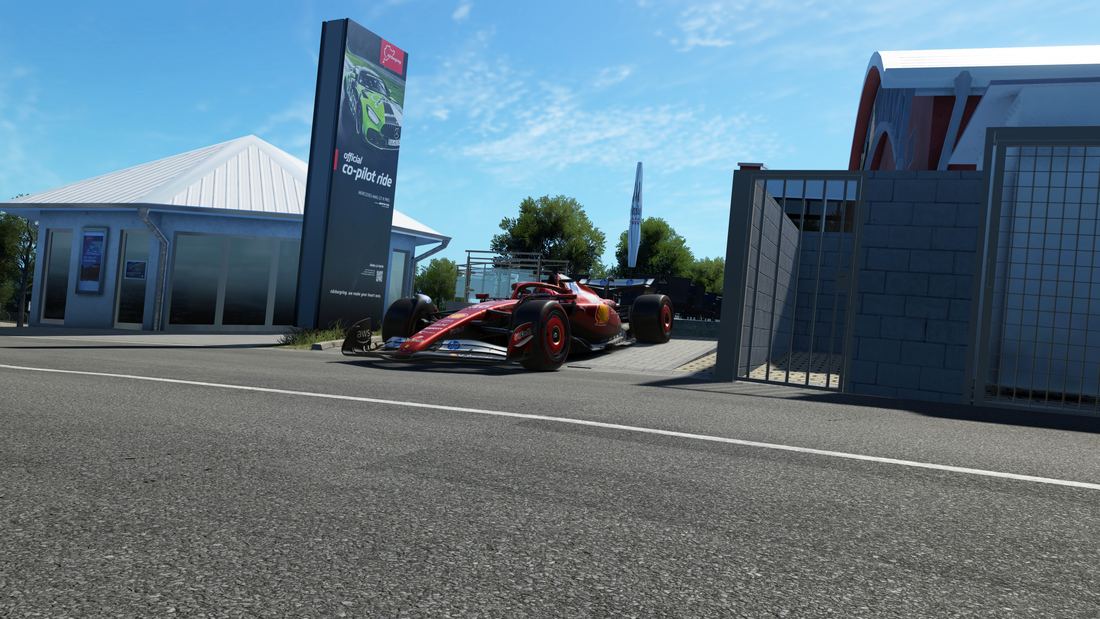
Un monoplaza cruzando el paddock
NürburgringUn monoplaza cruzando el paddock
Keep reading

If you like this one, try these

To go faster here

Guides that help you
at this circuit

Race here this week

Spa-Francorchamps is in the 24/7 server rotation. Subscribers vote on each week's track.

See the servers