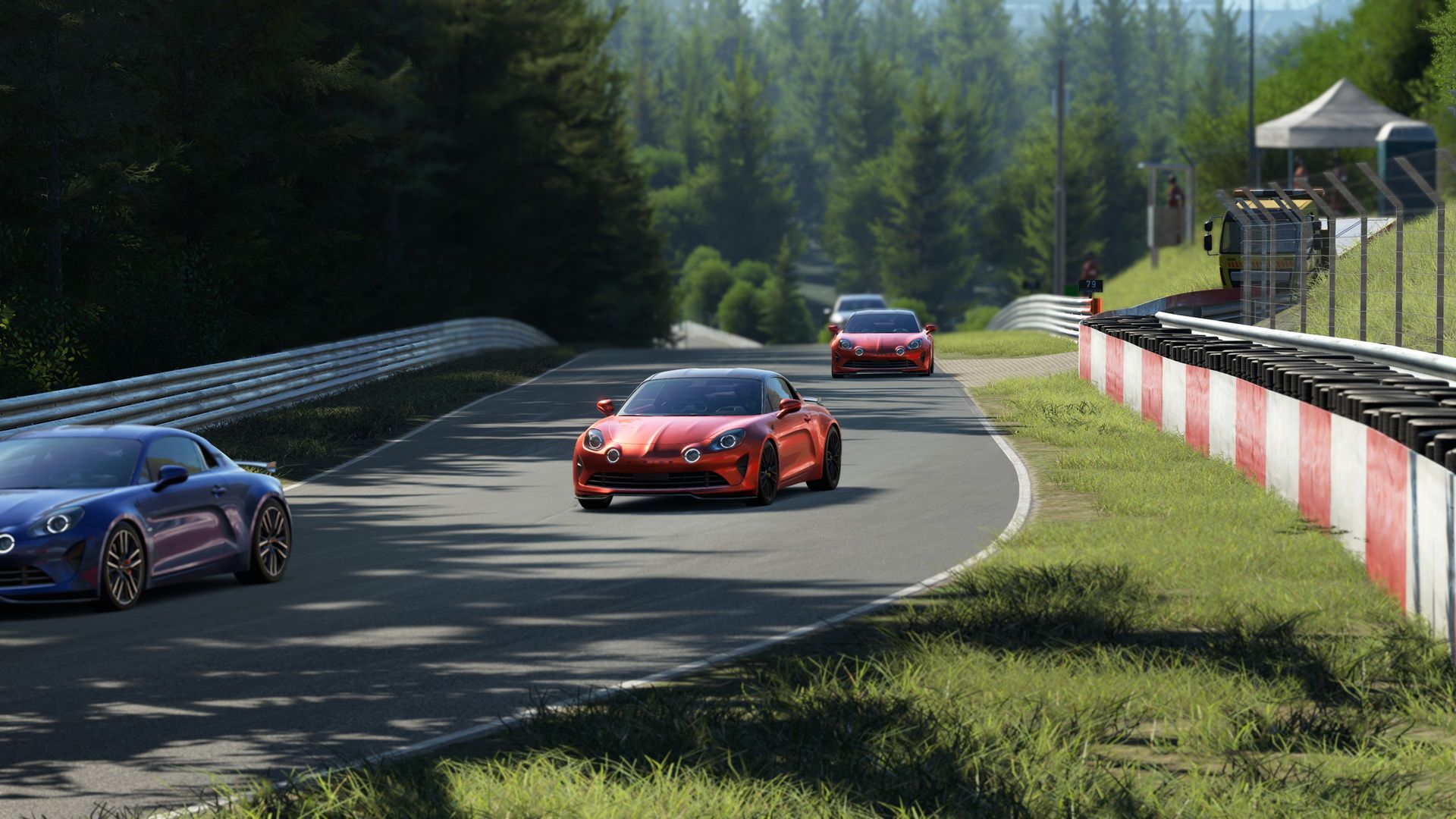
Three settings decide whether the game feels natural or impossible. They deserve fifteen minutes before your first lap.
The one most people have wrong and the one that costs the most time. If your field of view is too wide, everything looks distant and slow: you brake earlier than necessary without knowing why, and distances never add up.
It's calculated from two measurements: the width of your screen and the distance from your eyes to it. At first it will feel like you can see very little. That's the correct sensation. Explained in detail in this guide.
With too much gain the wheel feels heavy and tells you nothing, which is the most common mistake. What you need to feel is when the front axle stops gripping, and that disappears if you saturate the signal. Full method in force feedback settings.
Map from the start: pit limiter, lights, brake bias adjustment, aids if you'll change them in a race, and above all the look-behind view. Hunting for a key mid-race is how accidents happen.
The temptation is the fastest thing available. It's the worst possible advice.
A GT3 has so much grip, so much braking and so much electronics that it hides your mistakes. You go fast without understanding why, and the day you change cars you find out you learned nothing.
What works is starting with something that warns you before it goes:
When you can do five consecutive laps with similar times and no scares, move up a class. Then the GT3 becomes a pleasure, because you understand what the car is doing.
Start with something short, wide and full of clear references. You're learning to drive, not to memorise twenty kilometres.
What makes a good learning track:
What isn't a good idea to begin with is the Nordschleife. It's magnificent and it's a trap for beginners: twenty kilometres, no run-off and blind corners. Save it for when you can drive, and then follow the section-by-section method.
Starting with driver aids isn't cheating: it lets you concentrate on one thing at a time. What is a mistake is leaving them at maximum forever.
Recommended order, no rush:
In modern competition cars, ABS and traction control genuinely exist and using them is the realistic choice. Explained in this guide.
The signal is simple: when you can do five laps in a row without going off and with similar times. You don't need to be fast. You need to be predictable.
The natural first step is an open session, where nothing is at stake and you can get used to having cars around you. After that, a race with a grid.
Before that first race, read the full procedure: flags, pit lane, the start and the three rules that prevent almost every incident. It takes seven minutes and saves you the discomfort of learning it all live.
No. With a properly configured gamepad you'll learn tracks and lines perfectly well. A wheel mainly improves fine braking and catching slides.
Let the game manage it per car. Each vehicle has its own steering ratio, and forcing a fixed value makes some cars twitchy and others sluggish.
For learning where a new track goes, it helps. But turn it off as soon as you know it: staring at the line stops you looking far ahead, and looking far ahead is what makes you smooth.
Being decent takes a few hours. Being genuinely fast takes months. The good news is that improvement is continuous: almost everyone keeps lowering their times week after week for a long time.
What it is, why it rotates the car, how to practise it and the mistakes that end in a spin.
Read →What each click does, how it shows up at the rear axle and how to find your value.
Read →What each parameter does, what order to touch them in and how to spot clipping.
Read →When you want out of single player, the 24/7 is open practice: jump in with no commitment.
 assettocorsaevo